Author Archives: amateurinvestor

A sensible policy for cashing and saving dividends to invest in volatile high growth stocks at infrequently occurring low prices

Jan 21, 2017

In the market volatility in September 2015 and January 2016, the S&P fell 10% from its peak of 2126 on July 17 2015 to 1921 on September 4, 2015, before climbing again to a peak of 2099 in November 6, then falling 12%  to 1864 on February 12, 2016.  I did not have a source of cash with which to take advantage of some really attractive bottom prices in stocks, specifically ADBE.  I resolved to find a way to take advantage of the low prices which appear in market dips, as purchases made in teeth of market terror are key to producing the most outstanding returns.

The purchase additional stocks for the portfolio must be funded either from the sale of current holdings or from cash kept for the purpose (I do not consider the use of debt to be a sound option).

There are various arguments against the sale of current holdings to simultaneously fund new purchases.  The decision to buy is driven by the identification of a prospective purchase that is currently found at an attractive, low price, or where business prospects for the company appear to be more promising in the immediate future.  Meanwhile, to optimize return, the company that is sold to fund the purchase would be judged to have less promising prospects and hence likely to fall in price, either because it is currently judged to be overvalued,  or because business prospects appear uncertain in the near future.  But there is no particular reason that the advent of an attractively low price in the target purchase would coincide in time with an attractively high selling price in another holding.  Rather, one may be faced with the prospect of selling a stock at a merely reasonable price to enable the purchase of a stock which is found to be hopefully at a nadir.  Unfortunately, the decision can potentially be wrong on both sides, that is, the price of the target purchase may subsequently fall even more, while the sold stock may subsequently continue to rise.

A variation of this strategy is to sell a stock that seems overvalued, or is expected to fall in stock price, in order to build up a cash reserve to fund purchases of a stock in the future, rather than simultaneously.  The problem with this strategy is that it  based as it is on prediction of the future, a sketchy enterprise at best. 

Indeed, the problem with any approach based on predicting the future of stock prices is that stock prices do not necessarily reflect current business events in the company in question at all.  They may rather reflect the market’s shifting reaction to those events, in turn driven by entirely distinct and distantly related social or economic forces.  Because of this, a stock that seems overvalued, and thus a likely candidate for harvest, may continue to rise into regions of continued overvaluation if social or economic sentiment looks favorably upon it, against conventional rational business expectations.  In this case, the sale price would be regretfully too low, too soon. Or in fact one may decide the stock should after all have been held for the long term.  Conversely, the tide of market sentiment may tumble a stock even though the company is prosperous, producing regret that one did not harvest at the previous peak.

One characteristic of my investing approach is the attempt to recognize and understand the emotional currents underlying  investing decisions.  By doing so, one can steer a course that is free of emotional hazards to sound investing decisions.  In the present case, awareness (perhaps not fully conscious) of the shakiness of one’s predictions about future prices is likely to cause anxiety which interferes with rational trading decisions.

One cannot change a future outcome that one does not control, either before it happens, or after it has happened.  But since no one else can either, failure to do so does not impair one’s performance relative to other investors, that is, relative to the market.  What one can do is first, avoid the chances of making an error, while maximizing the chances of better results, and second, minimize the emotional influences which interfere with sound investing decisions. 

A different strategy is to build up cash reserves to fund stock purchase.  In the absence of new cash, the only possible source of these is stock dividends credited to cash instead of reinvested.   These have a few advantages as a source of cash.  First, the cash is contributed regularly, at a range of different stock prices, so that no bet is made that a particular price would have been the optimal selling price.   Thus, one avoids the chance of making a large error in choosing a sale price which may turn out later to have been the wrong one.  no specific decision must be made to sell a treasured holding, with the accompanying distress.  This will minimize the emotional turmoil which leads to hasty, ill thought out decisions.

There are thoughts pro and con this strategy.  Crediting dividends to cash means they will not participate in the hopefully continued rise in the stocks they were contributed from.  In order to make this strategy worthwhile, one needs to buy new investments at a low enough price, or to achieve a high enough return on investment, so that this will compensate for the time of missed returns before the cash was invested.

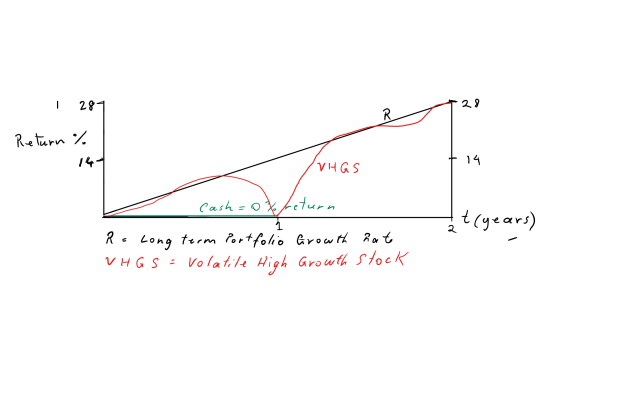
Purchasing at a discount from the long term stock growth rate is crucial to maximize the chance of a good outcome.  If the stock fits criteria for the portfolio, none of which depend on short term market action, then its long term growth rate should approximate that of the portfolio.  The cash that is held pending the new stock purchase has a return of 0%.  Let us assume that the stock to be purchased would have a certain price at the time of purchase, if the stock was adhering continually to the long term portfolio growth rate ( R ), and call this P (r).  Let us assume that at the time of purchase, the stock has fallen so that it is discounted in price P (r).   In order for the cash invested in the new purchase to attain the portfolio ( R ), then the discount from P (r) at which the new stock must be purchased must equal the time the cash was held, in years, t (cash), multiplied by ( R ).  The illustration below shows this for a stock bought with cash that has been held for one year.

stock-discount-chart

For cash held for less than a year, then the discount from P (r) would need to be relatively less, while still enabling the stock to attain the same portfolio ( R ).  One source of error in purchasing stocks, especially volatile high growth stocks, is failing to patiently wait for an adequately low price.  In my proposed strategy of using accumulating cashed dividends to fund new stock purchases, the fact that the cash balance builds up slowly as dividends are contributed, is an incentive to wait for an adequately low price so as to generate returns at least equal to ( R ).  This is because frequently making small investments which use up the accumulating cash, if made at a discount to P (r) which is less than t (cash) times ( R ), will result in subpar long term returns.

There remains one question: if the stated goal of a rational policy of accumulating cashed dividends and reinvesting them, is to merely match the long term growth rate of the portfolio that would be attained if the dividends had been automatically reinvested in their respective stocks in the first place, then what is the point of hoarding the dividend cash in the first place?

The reason is as follows:  some stocks seem to have a higher expected growth rate because of the strength of their business and market expansion.  However once this is well recognized by the market, the stock in question becomes chronically highly priced, and is rarely available at an attractive price.  However, these stocks can yield great returns if they can indeed be found cheaply.  And, inevitably they sooner or later do fall in price.  In fact, when a company from which the market has high expectations (ADBE), meets a setback, it is generally swiftly punished and its stock falls more than would be the case for a company with a solid business but from whom the market has more conventional expectations (Philip Morris International).  This type of company might be termed a Volatile High Growth Stock. The above strategy of accumulating cashed dividends to take advantage of these infrequent opportunities can then in fact lead to overall increased returns.

Again the promise of higher returns by a high growth stock is only likely to be fulfilled if the purchase price is low enough.  On this inarguable basis,  a sound strategy might be to buy the target stock with half of the available cash when it reaches a % discount from the previous 52 week peak, that is equal to the 10 year growth rate for the portfolio ( R ).  Should the target stock fall to 2 x ( R ) from the same previous peak price, then the remainder of available cash will be invested in it.

This strategy may not be perfect, for example it may result in only half of the available cash being invested in the target stock at an attractive price. On the other hand, it preserves the chance for purchase of at least some of the target stock at the truly great price of a 30% discount to previous peak. This approach should at least preserve the average portfolio growth rate from damage caused by ill-advised purchases.  Meanwhile, If the target stock is one with growth rate relatively higher than the average for the portfolio, this should raise the portfolio performance.


Bought more ADBE in 2016; reflection upon the emotional aspect of the trade

January 19, 2017.  On January 11, 2016 I sold 6.5% of my MSFT stake to buy ADBE.  I thus somewhat more than tripled my stake in ADBE, which nevertheless made up only 5% of my portfolio as of 12-31-2016.

The timing and pricing of this trade was as follows.  In August-September 2015 the market sold off by 10%, then recovered, only to sell of by approximately 12% in January 2016.  ADBE had bottomed on 8-24-2015 at 75, down 13% from its previous peak at 86 on 8-17-2015.  It then rose again to peak  at 95 on 12-29-2015 before falling 22% to nadir at 74 on 2-9-2016.

 I bought ADBE at 88 on 1-11-2016,  down less than 8% from the 12-29-2015 peak of 95.

In fact, since 1-11-2016 MSFT is up 20-83%, ADBE up 19.56% as of 1-18-2017.

But MSFT pays a dividend of 2.35% currently,  That trade isn’t looking too impressive. Bear in mind of course that the prices of both fluctuate, so on a different date, the assessment would be different.

Had I bought at the nadir of both stocks with MSFT at 75 and ADBE at 74 on 2-9-2016, since than ADBE up 46.24, MSFT up 26.89 not counting dividend, as of 1-18-2017.

adbe-msft-2016-chart

The rationale for the trade was that ADBE is a high PE stock with expectations of high future growth which have become well recognized by the market. This type of stock rarely trades at an attractive, relatively lower purchase price. I wanted to increase my holding of ADBE and wanted to take advantage of a lower price. I still agree with the decision to increase my holding of ADBE, but obviously I totally missed the true opportunity for a better price. 

This episodes proves again two timeless investing truths.  First, it is true that valuable and expensive stocks will be available at a better price, if you can only be patient.  Second, if you feel impelled to do something less you run out of time, just again, be patient. In fact using more time to decide will result in a better outcome.  This is not the only time that it would have been more profitable for me to wait for a better price.  In fact it is a recurring theme. 

But upon reflection, I find that this conventional lesson only probes one layer of this experience.  A distinct lesson is provided by considering the emotional aspects of the trade.

First, I felt I was missing out by not owning more of ADBE, a wonderful company with an insurmountable competitive advantage in its business (digital media) which it is strengthening, while building a second business (digital marketing) which looks likely also to have a sustainable competitive advantage.  This created a sense of urgency to trade.

Second, since I held no cash, I needed to sell another holding to buy more ADBE.  All of my 5 stocks are treasured holdings.  Part of holding such a concentrated portfolio is the nagging thought that perhaps I should be more diversified, at least within my 5 holdings.  This added to the anxiety surrounding the trade; on one hand, I should trade into ADBE, on the other hand, I was reluctant to sell my other holding.

the emotional aspects of investing must be explicitly embraced and addressed, rather than just suppressed.  Same as in the rest of life.  Remembering that good investing is a model for a fruitful life, lived to its fullest potential.

In perspective, the sum of money used for this trade was a very small proportion of my portfolio , less than 3%, as to make only a small difference at best.  This suggests that instinctive fear led me to avoid putting a healthy proportion of my portfolio on an investment.

Regarding strategies to reduce the roil of emotions interfering with sound trading next time.  One suggestion is to create a relatively fixed, preplanned trading strategy.

For instance,  wait until it is reduced 10% from the peak and use half of the money available for the sale.  Then use the rest when or if the 20% discount is reached.

This assumes that you really want to own the company.  If it is a new investment that may not have the same conviction as a better understood, long term holding, then waiting for the full 20% discount is probably best.

Second, in order to isolate the decision to purchase from the reluctance to sell a current holding, it would be helpful to have a source of cash for new purchases.  This is the topic of a subsequent post. 

The lesson to be learned from this episode is not just that patience is a virtue in investing.  For the barrier to patience is often posed by the emotions impelling a trade.  One cannot simply make one’s emotions disappear.  I for one, have been successful in making them disappear so far, and I am surely not alone. 

A better approach may be to 1. analyze the source of the emotions.  In my case, my rush to trade and poor decision making was not simply from a greedy rush to chase a hot stock.  By understanding the source of the feelings, you can know how to neutralize them.  2. have a strategy to avoid a repetition. For example, I will trade at specific target reductions in price, and not worry about trading until then, merely watching the market prices regularly.  I know my portfolio is sound as is, there is no urgency to trade unless it is actually at an attractive price.  3.  have a source of cash  for purchases.  Again, this point will be the subject of a different post.

In sum, the emotional aspects of investing must be explicitly embraced and addressed, rather than just suppressed.  Same as in the rest of life.  Remembering that good investing is a model for a fruitful life, lived to its fullest potential.

Continue reading

Essential Criteria of an Amateur Investor investment.

edited 4-4-2016
1.  Sustainable Competitive advantage defending or growing market share in its specific market.  This is the sine qua non of our investment choices and the foundation of our approach to investment.  The company with a competitive advantage is rare.  It is marked by the ability to increasingly attain returns on investment above its cost of capital, and above those of its competitors.  A competitive advantage might be made durable by low cost/high volume leadership among competitors; barrier to market entry of competitors; product differentiation/switching costs to customers.  The company with a sustainable competitive advantage sells an indispensable product.

2. No competitive advantage truly lasts for ever. Hence, a related critical facet of the competitive advantage feature is that management consistently anticipates or reacts to changes in the market or competitive landscape by finding profitable ways of extending the company’s competitive advantage into new markets that are tangibly related to its current markets. That is, the company adapts and evolves to perpetuate its competitive advantage by extending it into the evolving new markets.

3.  Evidence of devotion to shareholders by its capital allocation, manifested in the following ways
stock buybacks to reduce share count
avoiding excessive dilutive stock compensation
obtaining good returns on investments in acquisitions
aligning reward and performance of management and employees to reward shareholders and long term company performance
allowing shareholders to have voting power commensurate with their stock ownership.

4  Common stock of publically traded company based in U.S. or other relatively transparent legal environment with respect for property rights, at least 10 years old.

5. The investment worthy activities of the business are demonstrated in the record of its past and present achievements, not in the hoped for future.

6.  quantitative evidence of ability to obtain returns on investment above cost of capital, such as low debt level, growing free cash flow, high free cash/revenue, high gross margin, high ROE and ROI.

2015 a year of realization, refocus, and anti-diversification

Jan. 4, 2016.  Amateurinvestor beat the market soundly in 2015. The 1 year return was 23.7%; 3 year: 22.1%; 5 year: 21.6% and 10 year: 15.3%. The S&P 1 year return in 2015 was -0.73%. As of 1-5-2016, S&P 3 year return was 11.2%, 5 year return: 9.58%, 10 year return: 4.70%. Therefore I have approximately doubled the S&P returns for 3, 5 and 10 years.

The relative proportions of my holdings are as follows:

MSFT 48.75%
CNI 4.6%
SBUX 19.7%
V 24.7%
ADBE 1.4%

The portfolio is rather focused, in fact the number of stocks dropped from 8 at the beginning of the year to only 5 stocks today. I would like to share some thoughts regarding my sale of 2 companies this year, Cerner (CERN) and Intuit (INTU). I sold these because I realized their purchase was a mistake.

I bought Cerner in October 2013 at $57.75. Cerner is the largest dedicated digital medical records software provider, has an impressive gross margin and a business with a high proportion of recurring revenue and switching costs. I bought it because it has an impressive record of growth for over 35 years. It provides a software platform is a critical part of its client’s business operations. It has staying power and seemed to have a durable competitive advantage. At the time I bought it, I owned just 6 stocks, which seemed to me to be very few, even for a focused portfolio. It seemed wise to diversify into a new strong company I had found. I had a few small doubts at time of purchase. At the time CERN had risen because of recent success in agreements to sell its software and services to major medical centers, particularly Intermountain Healthcare in Utah. I knew it was richly valued. In addition, it regular buys shares to compensate for share based compensation, but still manages to continually increase its share count, which casts doubt on its dedication to shareholder value. Unfortunately, events have shown that because of its high valuation, any miss in analysts’ earnings/revenue estimates are met with a drop in the stock price. There has been some loss of important customers to competitors recently which casts a little doubt on the invincibility of its moat. I decided to sell on August 10. At this point I was uncertain how well it would recover from the market instability of that time. Moreover, I was provoked by a quarterly revenue miss. Overvalued stocks with evidence of weakness in their franchise do not do well in market downturns. I sold at $65.40, at a modest gain, so the damage was limited. On Jan 6, 2016, CERN was at $57.9.

My error in this case was a failure to understand the Cerner business well enough either to a. be convinced that its earnings would continue to grow safely in spite of current overvaluation and related vulnerability to temporary downturns, or b. realize that it’s competitive advantage and dedication to shareholders were lacking and therefore not good enough to earn a place in my portfolio.

Underlying this mistake is a more fundamental and common error, that of impatience. I could have simply taken the necessary time to analyze the company before buying. Had I done so, CERN would have been available at a little less than $50 several months later in May 2014. In any case, the allocation at the time of purchase was approximately 0.8% of the portfolio, so the damage was bound to be limited. I cautiously limited my allocation because of my trepidation regarding valuation and other factors mentioned above. In fact, one might ask what was even the point of investing such a small amount in this company. To this I can only reply that I acted from intuition instead of analysis. The advantage of this is that it certainly limited the damage caused, while adding experience. The avoidance of serious mistakes is an important part of investing success.

Upon reflection, I note that I cautiously limited the size of my allocation, and also that I feel a needed a deeper understanding of the company, and that I could have been more patient. We will revisit these points later.

Intuit is an apparently attractive business, with a dominant share in small business accounting software, and market leading shares in retail DIY tax software and professional accountant tax software. As are Cerner, Microsoft (one of my favorite investments) Intuit was a survivor of the early 1980s boom in computing. As with Cerner, it seemed to be a judicious addition of a long lasting company with clear competitive advantages to my portfolio of so called eternal companies. I bought it in February 2015 at $91.00. It seemed somewhat overvalued but I attributed this to the well-established strength of its franchise. It has introduced Quickbooks Online, a cloud based version of its dominant Quickbooks small business accounting software. Other than Turbo tax, the market leading consumer tax software, the other anchor of its competitive advantage is (was) Quicken, software for home finance management.

In August 2015, again at a time of market turmoil, Intuit management made some capital allocation decisions which shook my confidence in their competence, namely the decision to divest Demandforce and Quicken. Intuit had acquired Demnandforce, an email marketing company for small businesses, in 2012 for $423.5 million. Intuit thought to integrate it with Quickbooks. 3 Years later, CEO Smith explained the abrupt decision to divest this recent acquisition made for over 10% of its 2012 revenue at the related investor presentation. He matter of factly stated that Demandforce and QuickBase [another business divested at the same time) are great businesses, but they do not support the QuickBooks Online Ecosystem and both serve customers that are up-market from our core small business customers.” When asked by an analyst to address Intuit’s record of acquisitions, he stated “many of the larger ones have not gone well”. “…We have a mixed record in terms of bolt-on businesses, new businesses that may not plug-in directly with QuickBooks or tax businesses…” and promised that management had developed a “set of criteria that [future acquisitions] have to meet”. In other words, he was promising that 32 years after its founding in 1983, Intuit would begin to ensure acquisitions make sense for the company before purchase. Obviously these words are not those of a CEO of an eternal company. Quicken was one of its original businesses at the founding and was providing over 20% of revenue in FY 2014. I was surprised by the decision to divest this instead of adapting it and continuing growth.

The poorly planned capital allocation into Demandforce and the abrupt divestiture of Quicken gave me the impression that Intuit management may not be able to adapt successfully to future markets. I had bought in February 2015 at $91.02 and sold in September at 89.26. I found it difficult to pinpoint where I went wrong here. Intuit seemed to be a sound and strong business, providing necessary products which had market leading shares. Perhaps if I had read more of the past financial reports, I would have discovered other episodes of poor acquisitions. Perhaps I should have simply observed its progress over enough time to get a more detailed impression of how it functions. Prior to its purchase, I had considered Intuit to be a strong business with an economic moat which was akin to those I owned. I actually sold shares in Visa and Starbucks, both of which were highly valued by conventional measures such as cash return, to buy Intuit. As happened with Cerner, I felt I lacked deep enough understanding of the company and its management, without which I was vulnerable to nasty surprises.

In the case of both Cerner and Intuit, I felt surprised by adverse company events, and retrenched back to my long term holdings. Therefore, 2015 was a year of realization, that buying companies which seem to be good businesses, and even to have a durable competitive advantage, is not enough. they must be observed to dominate their markets for the foreseeable future, and be observed to demonstrate management competence and respect for shareholders over some time, until one is convinced.

But how is one to judge when the evidence is enough to justify buying and holding forever? Sometimes the clue to a solution to a life problem can be found in a careful reflection upon the experience, and asking the question, “how did it make you feel”. This is because the correction solution is only correct if it is the right one for yourself. In the case of investing, as Benjamin Graham stated, “the investor’s chief problem, and even his worst enemy, is likely to be himself” (Intelligent Investor). The investor will need to be comfortable holding his security in the face of inevitable market fluctuations. In this case, as previously noted, I reflected that I did not feel I had a profound enough understanding of the company to feel comfortable holding in the face of a market downturn. The solution then is to wait and continue to analyze the company until I feel I know it well enough to be able to commit, or not. There are also cases of companies which are actually worthy, but seem overpriced, in which case one would wait for a market downturn even after having come to understand the company sufficiently.

This process of coming to understand the company is not purely intellectual. For example, I doubt a simple analysis of financial statements prepare one for Intuit CEO Smith’s rather absurd explanation of his failed acquisition of Demandforce. I believe rather than one must experience the company as much as is possible via its communications, perhaps its products, and by communicating when possible with clients, customers, employees. One must build a relationship with the company, until one feels one can trust it. This is actually what the legendary investor Philip Fisher (author of the book Common Stocks and Uncommon Profits) termed “scuttlebutt”, the flow of information he held indispensable for analyzing a growth stock.

Exploring a company which seems promising, and might rise in value, while waiting to feel fully comfortable enough to commit before buying, is difficult for two reasons. First, it requires patience. Inevitable, one is afraid of missing a low price. Second, it is surprisingly difficult to be motivated to really experience a company, to form a relationship with it, unless you have an interest in it. This may lie behind the investing approach of the excellent hedge fund ValueAct Capital. The investment staff study a company until it seems to be a good bet, then buy a small share and continue to follow it until they know it well enough to feel they know how it makes money, and what to expect from it. They then deepen the relationship by buying a stake large enough to command a board seat, and continue becoming part of it. Perhaps by buying a small stake in a company, I can be motivated to follow it closely enough to understand it better. Seen in the light of these thoughts, perhaps my cautious forays into new additions to my portfolio may not be faulted too much, but in fact be considered a necessary step to taking the time to come to know a company. And by limiting the size of initial investment, I limited the damage caused by errors. But the benefit is that this might be a way to actually discover new gems. Such was indeed the case with Adobe, a small investment I made which was turned out to be a wonderful investment.

Finally, 2015 was a year of anti-diversification, the acceptance that there are truly few companies which have exhibited the qualities of an eternal company in a lasting way, and acceptance that there is no need to diversity just for its own sake. In 2015 I sold Visa and Starbucks, which I had owned for years, and which I knew where companies with very strong franchises, to buy a new company, INTU, which I was less familiar with. Having corrected this error, my portfolio was whittled down to 5 companies. This time, I feel happy with the small number.

But again, reflecting upon this retrenchment back into my small collection of investment gems, I find that the high degree of comfort I have with my existing portfolio, continually reinforces the reluctance to invest in new companies. As my understanding of and satisfaction with my exclusive set of existing investments grows, this sets a higher bar for new companies to meet. And this may actually be an anti-diversification mechanism by which focus investing reinforces its own success.

The restaurant experience builds the brand, and the packaged product monetizes it.

Dec. 9, 2025.  One strategy of competitive advantage is to afford a unique experience that is preferred by the customer.  Food or beverages are good examples of the type of product that can represent this type of familiar, sought after experience because they are intimately experienced by the user, and can become part of the customer’s personal life habits.  In order to possess a competitive advantage the food or beverage must be of a quality unique enough so that it cannot be easily duplicated.  In order to possess pricing power, the quality must be both unique and recognized as being outstanding.  For food/beverage purchased in a restaurant, the atmosphere, clientele and location of the restaurant are part of the experience.  The restaurant environment is controlled to convey a specific experience and this strengthens the consistent branded experience.   Lacking this complex tool to control the customer experience, the packaged beverage industry is extremely competitive.  Brands fight to establish a vivid appeal based on their packaging or advertising.

However, the packaged beverage industry can have relatively high margins.  Assuming the product’s appeal can secure pricing power, margins can be healthy for what is essentially a relatively cheap product based on commodities (sugar, coffee, flavorings…) with some degree of intellectual property in the recipe.  Meanwhile, the restaurant bears the costs of real estate which can be high in sought after locations, as well as costs of the retail operation which are relatively high, particularly for fresh or very high quality product.  So the packaged product is relatively profitable, but struggles to make more than a fleeting connection with the customer.  Meanwhile, the restaurant can foster a bonding experience with the target customer, but bears the costs of real estate and the retail operation.

What if a company could have both appealing restaurants which served delicious and excellent beverages and foods, and also widely marketed packaged products?  The restaurant experience could establish a bond with the customer.  The relatively higher margin packaged product could benefit from the bond that was forged in the more deliberately pleasurable experience of the restaurant.  This bond could never be duplicated in the grocery, supermarket or convenience store aisle.  The company would therefore have a competitive advantage over rivals who do not have that restaurant experience brand building mechanism.  It is said that Brand confers a competitive advantage.  In fact a strong Brand results from a superior product, including the experience by the customer of the product.  What a  strong Brand does make possible is pricing power.  In the present example, the unique restaurant experience enables pricing power for the packaged product.

This is a strategy that Starbucks is using to continue developing its brand experience, while building out a relatively high margin packaged good product that will extend Starbucks sales far more widely than would be possible merely by increasing the number of its restaurants.  Of note, roughly 80% of coffee is drunk out of restaurants, at home.  This market must be addressed with packaged coffee and coffee beverages.

There is another issue with relying solely on a strategy of expanding the base of restaurants in order to grow sales.  A high rate of restaurant expansion risks impairing the quality of the experience, through poorly trained staff or mediocre product.  In order to maintain the quality experience which is crucial in order to nurture the relationship with customers, the quality of the restaurant experience must be preserved and itself nurtured.

Starbucks could leverage the café experience into packaged products to increase earnings over the long term.

SBUX has made several moves recently to increase its store sales, including premium delivery services, ordering in advance on a mobile app to shorten store queues, and strengthening food offerings and adding non-coffee refreshments including wine, to increase sales at various day times.

These speak to an outstanding ability to continue adapting to pursue growth.  But can Starbucks stores retain their Starbucks character if they increase food sales volume enough to become a staple for travelling motorists, as McDonalds is?  Surely in the future, profitability of store sales growth will increasingly depend on increasing volume and lowering costs.  For now, the highest store sales growth is in Asia, where Starbucks are mobbed.  But surely this is due to their novelty, and not something that can be expected to continue indefinitely.

As store sales level off in the future,  it is Starbucks’ Channel Development segment packaged products that will keep earnings growing much farther into the future than would be the case if we were speaking of a pure restaurant company.

Starbucks has a somewhat unique advantage in that it has two distinct ways of approaching the customer.  One is centered in the “Starbucks Experience” of the retail and franchise stores, where pricey, hand crafted, customized coffees and refreshments as well as snacks are offered.  The coffee is of the finest quality, with matching price, and roasted in a specific way that often accentuates a certain “burnt” character.  The store atmosphere is managed, pleasurably social but relaxed, inspiring yet cozy, alive with the fragrance of fresh brewed coffee, and moreover reflects its local community.    The other approach is embodied in the channel development reportable segment (there are four reportable segments:  Americas; Europe, Middle East, Africa (EMEA); China/Asia Pacific (CAP) and Channel Development).  This reports sales from the Consumer Packaged Goods and Foodservice operations.  Channel Development sales include ready to drink versions of some of those same premium beverages (such as Frappuccinos®, Doubleshot®, Refreshers; Tazo® tea and Starbucks branded single serve products, notable the K-cup; roasted packaged coffee, Tazo teas; and standardized brews of its Seattle Coffee mass market brand and other products sold to foodservice accounts.  These are sold in ,  grocery stores, warehouse clubs, specialty retailers, convenience stores, cafeterias, hotels, restaurants and other mass market venues.

With this two pronged strategy, on one hand, painstakingly building its brand, and on the other, selling it in every conceivable venue, Starbucks could be the Ritz Carlton of coffee shops, and a Coca-Cola like supplier of products that signify the Starbucks experience to consumers in the full diversity of their everyday circumstances (“at home, at work or on the go”).

In my view there are two primary keys to the destiny of Starbucks as a long term growth company.  One is preserving the integrity of the Starbucks coffee shop experience, and enriching this to be unique and expressive of the fullest potential of its beverages.    The other is continuing to grow the packaged product business in a cost effective way, preserving control of the brands, recipes and intellectual property, while partnering with manufacturing/bottling or distributing companies to achieve wide distribution.

These two mutually dependent arms are linked by the brand.  The power of the brand to influence consumer behavior relies on the richness and authentic service of the coffee shop experience in which is it rooted.  Years ago, after the Starbucks salted caramel hot chocolate drink had been withdrawn from stores, I commented to a Barista at my local Starbucks that my little son had loved it, and its taste had reminded me of a childhood desert that I could not quite place.  She reflected dreamily for a moment and then hopefully volunteered that “but we can still make it for you from scratch”.  As long as Baristas can make the drink that you dream of for you “from scratch”, Starbucks brand is thriving.  Thus, an office worker drinking a k cup at work is not just drinking ready hastily brewed ready to drink coffee at her desk.  She is thinking of the cozy bustle and aromas of the Starbucks coffee shop and associated pleasant memories. This experience is the crucial basis for the influence of the Starbucks brand. Without the experiential basis of the imperfect, authentic, aromatic Starbucks coffee shop, the Channel Development goods is just another brand of manufactured beverages fighting for consumer attention on the supermarket shelf.

Starbucks retail stores and Channel Development have business models that strengthen each other.  The greater margin of branded packaged drinks can allow the coffee shop business model to provide more luxury and focus on serving each specific customer as fully as possible (Ritz Carlton), freed from the need to maximize volume and commoditize service order to grow profits.  In fact, in order to preserve the authentic quality of the coffee, shop, it may be advantageous to avoid a rate of growth in shops that would lead to the perception of commoditization in the environment, furnishings, or service.

Continued nurture of the actual Starbucks store experience should tend to diminish the dependence on advertising as brand building.  This is borne out by a review of relative advertising expenses of Coca-Cola and Starbucks.  Coca-Cola spent 6.8%, 7.0% and 7.6% of revenue on advertising respectively for 2012, 2013 and 2014.  Whereas Starbucks spent 1.3%m 1.3% and 1.2% of revenue in the same years.

While a company that does not depend on its own retail stores may achieve a higher gross profit, the experientially based Starbucks brand may be more robust than one built purely as an image in TV commercials, billboards and package logos.  The brand may be significantly less affected by changing consumer trends, as it is anchored in the actual daily experience of the coffee shop, where customers can be educated as well as observed.

Perhaps the living spring of Starbucks branding has contributed to recent growth in Channel Development.

Analysis of channel development and total Starbucks consolidated revenue and operating income over the past 10 years from 2005 to 2014 reveals that Channel Development revenue has increased by 6.2 times, from $249.3 million to $1.546B , more than double the rate of growth of total Starbucks consolidated revenue which has grown 2.58 times  from $6.3936B to $16.4478B.

Today Channel Dev revenue and operating income rank second among the Starbucks segments,  but still only 9.4% of total consolidated revenue.  Operating income at 557.2 million is 18% of total OI of 3081.1 million.

Channel Development sales are made mainly via joint ventures and licensing arrangements with large consumer products business partners. This operating model leverages the business partners’ existing infrastructures and as a result, the CPG segment reflects relatively lower revenues, a modest cost structure, and a resulting higher operating margin, compared to the Company’s other two reporting segments, which consist primarily of retail stores.  As such, Relative operating costs for the channel Development segment are much smaller than for the retail store segments, because store related costs are absent.  As a result,  operating income/total revenue ratio in the channel development segment has always been higher, currently has the highest operating margin of all Starbucks segments, now almost double at 36%, that of Starbucks as a whole at 18.7% .  Channel Development products are now sold in 39 countries.

As recounted in the recent Annual Shareholders’ Meeting, recent Channel Development growth is driven particularly by K cups. Starbucks K cups have achieved better than market growth rate since launch in late 2011 and Starbucks has achieved a leading market share, sales grew 34% from 2013 to 2014.  More broadly, since 80% of coffee is drunk in places other than coffee shops (mainly at home), Starbucks leadership aims to expand into this market.  single-serve is the fastest growing segment of the at-home coffee market in the U.S., which is led by K-cup packs. Packaged coffee is another important product in home brewed coffee.  While grocery store coffee sales are increasing at 10% annually, Starbucks packaged coffee sales are growing at 18%, with a 22% share of the U.S. premium coffee market, which is the leading market position in both premium roast and ground and the single-serve categories.

The expansion of single serve and packaged coffees is fueled by introduction of innovative flavors and high quality varieties such as single origin coffees.  The market for Ready to drink coffee beverages, followed by packaged coffee, for home consumption, is large and growing internationally as in US.  Starbucks aims to be the market leader in premium coffee market globally.  In fact, as described by Michael Conway , president of the Channel Development segment at Shareholders Meeting.  Starbucks aims to double international ready-to-drink business over 5 years. One of the biggest opportunities is in China, where the ready-to-drink coffee beverage market is a $6 billion category and is forecast to grow by 20% over the next 3 years. The China stores have been extremely popular and foment an awareness of and desire for Starbucks products, as well as serving as distribution centers hitherto. today, you can buy bottled Frappuccino is distributed in SBUX retail stores and grocery or convenience stores.

Starbucks is aggressively ramping distribution of ready to drink coffee in China.  At the Annual Shareholders Meeting, Mr. Conway announced a strategic partnership with Tingyi, one of China’s largest beverage players with products in over 1.1 million stores in China. Tingyi will provide local manufacturing, sales and distribution throughout while Starbucks will contribute “coffee expertise” (presumably IP including recipes) and brand recognition.

Tingyi Holding Corp launched in 1992, its Group of Subsidiaries produces and distributes instant noodles, beverages and instant food products in PRC.  Since 2012 the Group has had an exclusive alliance with PepsiCo to manufacture, bottle, package and distribute PepsiCo drinks in PRC.  According to its 2013 financial statements, the Group has leading market shares in instant noodles, ready to drink teas, bottled water, juice and egg rolls.   It held a number 2 market share in carbonated drinks with Pepsi.

The Group distributes via an extensive network of sales offices, warehouses serving over 30 thousand wholesalers and over 110 thousand direct retailers.  The Group leadership aims to strengthen its logistics and sales network in the PRC to attain market dominance.

A brief review of the 2013 Tingyi financial statement reveals that because of the need for substantial capital investment, while revenue has more than doubled from $5B in 2009 to $10.9B in 2013, profit was unchanged at approximately $500 million. In that time, property plant and equipment, lease payments, debt more than doubled.

This insight shows why it makes sense for Starbucks to partner with Tingyi while avoiding the expense and hazards of building out a competing world-class distribution network.

Channel Development aims to grow top line by 60% and nearly double profit by 2019.  It aims to “connect people to Starbucks around the world where they live, work and play. ”  That is, it allows the widest possible number of consumers to experience the Starbucks brand, in the full range of their daily activities.

There are likely issues in the future perhaps related to differing tastes in different regions, competition by other already existing or new brands.  The expansion of ready to drink Starbucks beverages is scarcely a sure thing.  However it is perhaps slightly less of a gamble than the prospect of established a booming coffee shop business in a nation of culturally devoted tea drinkers, which Starbucks has already achieved.

Cash return (Free Cash Flow/ Enterprise Value) of 3.1%, is not impressive. The PE is 28.2.  Excluding 2012, average PE in past 10 years was 32.4.  Given the rate at which Starbucks is increasing earnings, although there is no margin of safety in the sense that the stock is not undervalued, future performance, assuming the company continues to perform as it has, should give a corresponding rate of return, subject to the vagaries of the market.   Most likely best would be to wait for a dip in the market if one’s intent is to obtain a market beating return.  Alternatively one could invest a relatively small sum with a plan to wait an extended period for the investment to achieve a return powered by the Starbucks earnings machine unaided by the starting boost of a favorable price.

Between 2005 and 2014, revenue increased from $6.369B to $16.448B, net income from $494 million to $2.068B, and because of regular share buybacks, EPS grew from $0.61 to $2.71, for an average annual growth rate of 13.23% .

Management must defend and extend competitive advantage

Dec. 8, 2015.  The first criterion for an eternal investment is the presence of a durable competitive advantage.  This means other companies are not able to compete with the company in its markets.    But there a critical second two aspect of this feature. An impregnable competitive advantage by itself is not enough to confer everlasting earnings growth.  A second critical facet of this feature is that management consistently anticipates or reacts to changes in the market or competitive landscape by finding profitable ways of extending the company’s competitive advantage into new markets that are tangibly related to its current markets. As technology evolves to change markets and create new markets, the company adapts to meet new demands. Otherwise, other so called “disruptive” companies will meet the demands of those new markets. in some cases, new technology can abruptly threaten a company’s product with obsolescence. Then, the company must either change its business to adapt to the new market, change to serving a market related to its original product, or fold. The cash built up through its current strong franchise, and expertise in serving the current market, should give the company a head start in adapting to change. But in order to execute this, management must maintain a culture which detects looming changes, proactively develops new initiatives and enforces profitability. Indeed, it is management culture that establishes dominance in different, evolving markets over the history of a long lived, “eternal company”. The continuation of a company’s competitive advantage into the future is not guaranteed, but shaped by management culture.

One might say that no competitive advantage is truly eternal.  The foreseeable future inevitably gives way unforeseen innovations.  Competing companies use these to erode the formerly dominant company’s market share.  Undoubtedly this does occur, and recently there is much talk of “disruptive innovation”.  In many cases the problem may be more that management of company A does not efficiently enable utilization of novel tools to maintain its domination.  Or, does not imaginatively envision how the new tools can be used to extend its markets. This might apply to Microsoft in the years between 2000 and 2014, when it seemed to focus more on maximizing profit from the windows, office, server franchise, rather than expanding into new markets for its software afforded by digital readers and mobile phones. In fact, arguably Microsoft’s own management which impaired its revenue growth, as much as the strength of Apple or Google.  In other words, it is not that android or iOS phones have destroyed the market for Microsoft Office products, far from it.  Rather, they have created a large new market for mobile computing, a market related to Microsoft’s market for its productivity software.  And Microsoft has failed to extend its dominance into this new, related market.  In 2014, in a vigorous departure by new CEO Nadella, Microsoft began making a concerted attempt to forge into the market for mobile productivity software, for example by releasing Office for iOS and Android.  More interestingly, work on this software had begun under the previous CEO Balmer.  But more interestingly still, the strategy of creating Microsoft applications for other companies’ platforms had been heavily utilized in earlier Microsoft history, so it was actually part of the engineering and management culture.

AmateurInvestor 15.4% 10 yr return beats S&P (5.2%), Berkshire Hathaway (8.69%) for Oct 2015.

Nov. 27, 2015.  My portfolio beat the market this year as well as for the past 10 years. I also beat the 10 (8.69%), 5(10.92%), 1(-8.77%) and YTD (-10.49%) returns of Berkshire Hathaway (Brk.a).  Just saying.

This year’s outperformance is partly due to a realization that the focused portfolio is focused for a reason.  In late 2013 and early 2014 I added some stocks which seemed to fit the criteria to be an Eternal Company, but I could not explain fully why they did.  I did this because owning no more than 4 stocks (V, SBUX, MSFT, PM) felt a little unsettling.  I felt that stringently requiring that they manifestly exhibit the required criteria seemed unrealistic, given that so few companies with these qualities exist.  And so I acquired some more companies, described below, and later sold them. Performance will have been improved by pruning  these companies.

The good results were also related to investments in new additions to the portfolio  which have become permanent investments and have contributed to growth.

In 2015 my portfolio ended with 5 stocks, V, SBUX, MSFT, ADBE, CNI.

This chapter resulted in a few lessons learned.  In the search for Eternal Companies, possibly it is difficult to be adequately motivated to research the company unless you have an ownership stake.  I am reminded that the ValueAct Capital hedge fund acquires a small stake in prospective investments after having done preliminary research, and then continues to perform intensive investigation sufficient to enable a profound understand of how the company makes money and the issues facing growth, before making a definitive investment.  ValueAct is a focused fund.  I suppose I will need to find a way to be more conscientious about researching new opportunities.

The reality that there are very few qualified Eternal Companies does not mean that  investments made in companies that fail to qualify as such will still be as good.  Rather, the dearth of Eternal Companies means an investment strategy focused on these will indeed result in a relatively focused fund.  There is no way around this.  Having proved this more fully to myself, I now feel more content remaining with my exclusive selection of companies.

Another lesson is that I am still capable of making errors.  Fortunately, I am scrutinizing my own execution fully enough to correct errors before they cause serious damage.  Conversely, I am still capable of learning.

Here may lie the most important lesson. Namely, that I can improve the way I invest.  What tools might be best to address the issue at hand, that of picking a company which does not demonstrably meet the required criteria?  One tool might be to write out the reasons justifying investment, as well as any weaknesses with the company, prior to buying.  The narrative would cover a checklist of criteria critical for a good investment. Judgement regarding the criteria is gained by reading, as well as experience. The final analysis should be subject to a critical reading, in which the key assessment can be characterized as asking the question, “does this investment jump out at me as an obvious great investment?” There should be no doubt.

What are the most important qualities of an Eternal Company?  First, the existence of a durable competitive advantage.  This means other companies are not able to compete with the company in its markets.  Second, management consistently  anticipates or reacts to changes in the market or competitive landscape by finding ways of extending the company’s competitive advantage into new markets in a profitable way.

Note that this is entirely different from simply using its financial strength in a attempt to establish a foothold in markets which are entirely new to the company.

Below is a comparison of my returns with those of some renowned value investing mutual funds.

Fund/index Expense ratio (%) 10y (%) 5y (%) 1y (%) Ytd (%)
S&P 500 5.12 11.75 1.06 1.46
Amateur Investor   15.4 22.4 22.0 21.14(as of 11-25-15, est.)
Oakmark Select Fund (OAKLX) 0.95 7.68 14.67 -2.08 -1.08
Sequoia Fund (SEQUX) 1.0 7.28 12.14 -7.71 -8.68

Data is taken from Morningstar.

Following is a brief outline of the qualitative changes to the portfolio in the last couple of years. The companies I bought and subsequently sold at minimal loss – to  – modest profit were as follows:   Fomento Economico Mexicano (FMX, the Mexican Coca Cola bottler and owner of the Mexican convenience store chain Oxxo); Ebay (EBAY, operator of the online auction platform, online conventional merchant marketplace and PayPal, the latter subsequently spun off); Cerner (CERN, the largest dedicated electronic medical records provider); Intuit (INTU, with a dominant market share in desktop personal finance software with Quicken, small business accounting software Quickbooks, as well as growing businesses in consumer electronic tax returns with TurboTax.

I discovered two companies which have become permanent investments.  One is a true Eternal Company, Canadian National Railroad (CNI, one of the seven remaining class I railroads in North America, has the lowest operating ratio of any rail on this planet, and other features that enable it to grow by focusing on growing their customer’s and their own business as opposed to competing on price).

The second addition to my portfolio is Adobe (ADBE software dominates the market for creative professionals, Adobe is now increasing profitability as well as market by shifting from permanent to subscription licensing in the cloud, and in a related market has created software to manage digital media campaigns which is growing in dominance.

Finally, I sold, with some sadness, an Eternal Company for which growth in earnings has recently become stunted partly by a slowing of its market growth, and in addition by the effect of the strong dollar, since its earnings are all outside  the US: Philip Morris International (PM, which has the strongest portfolio of cigarette brands outside the US and is innovating in reduced risk cigarettes).  It cannot match the growth of my other stocks.

Philip Morris Intl., for the first time, an actually better product, and better for you!

Nov. 1, 2014.  Like everything else, competitive advantages are not everlasting. Even the strongest company must sooner or later defend its business against competition. Moreover in a changing economy presenting threats and opportunities, it must adapt by extending its market dominance into new markets or modifying its products and brand to meet new market needs. Philip Morris International Inc. is successfully taking on such a challenge, and is likely to gain market share as a result.

In the last 20 years, the cigarette markets has been profoundly shaped by public health concerns over health effects of smoking.  Governments have increased excise taxes, used minimum price laws and restricted smoking in public places or social locations.  Smokers have faced greater expense, decreased liberty to smoke in many locations, and stigma.

The governmental push for curtailment of conventional cigarette use presented a challenge to cigarette makers to produce a cigarette alternative which is less harmful.  Meanwhile, the growth of e-vapor cigarette alternatives is driven by lower price particularly for e-liquid products, and smoker desire to avoid the health hazards of smoking, the smoke, ash and unpleasant smells associated with their habit. However while smokers show much interest, these devices do not fully respond to adult smoker preferences due to lack of taste and sensory satisfaction, nicotine absorption being much slower than in cigarettes.

PM has engineered a comprehensive and innovative response to these challenges.  As recounted at the Philip Morris International Inc. Investor Day conference on June 26 2014, PM anticipated the need for reduced risk products (RRPs) and pioneered their development, having set out building RRP capabilities in 2003.  Their approach was not merely to build another e-cigarette.  They understood that success depended on two factors: first, evidence of risk reduction based on sound scientific research.  This would enable compliance with regulatory requirements.  Second, preservation of key expects of the smoker experience, to as to secure acceptance by smokers.  Failure in either of there would leave the new products vulnerable to regulatory curtailment, or would fail with smokers.

PM built a unique capability to develop RRPs, investing $2B on research, development, scientific substantiation and adult smoker understanding.  In addition to hiring over 300 world class scientists and engineers in key areas, they built a regulatory affairs group to guide their efforts in the emerging government regulation of RRP in all jurisdictions.

These comprehensive efforts resulted in a unique series of products.  Like the makers of other cigarette alternatives, PM’s reduced risk efforts rely on the fact that it is not nicotine that is primarily responsible for adverse health effects of smoking, rather, these are caused by the myriad substances contained in the smoke itself.  But unlike current e-cigarettes, PM’s devices achieve a rate of absorption of nicotine which is as quick as with a combustible cigarette.  This results in the anticipated “hit” that is key for smoker acceptance, and which current e-cigarettes lack.  PM research suggests that while current smokers commonly try out e-cigarettes, few stick with them.  This indicates a large potential market for PM’s reduced risk products among smokers who are dissatisfied with current e-cigarettes.

The series of products that PM has created will be released in coming years.  The first to market will be iQOS.  This consists of a Marlboro branded tobacco “heat stick” similar to a cigarette that is heated but not burned in order to liberate inhaled nicotine vapor bearing the full tobacco flavor.  A second heat-not-burn product termed Platform 2 is undergoing clinical studies and will launch as a pilot in cities in 2016. Platform 2 preserves even the lighting up phase of the cigarette ritual. It contains a capsule of pressed carbon which burns, but is separated from the tobacco stick portion of the cigarette like design, which is heated without burning. Clinical studies are underway and city pilot studies are planned for 2016.

PM also has two e-cigarette designs in development, using novel aerosolization technologies that give nicotine delivery profile superior to existing e-vapor devices. These will target current users of e-liquid or e-cigarettes.

PM’s aspiration is to demonstrate that their products has a risk reduction profile approaching that of cessation.  Toxicological and short-term clinical studies for Platform 1 showed that biomarkers of exposure in users of Platform 1 were much reduced/similar to smoking cessation.  This supports a claim that iQOS use results in exposure to potentially harmful products which is much reduced compared with conventional cigarettes.  Longer-term reduced exposure studies are ongoing.  These will measure the changes in clinical risk endpoints including biomarkers of exposure.  Similar clinical studies for Platform 2 are planned.

Development of PM RRPs has been executed in accordance with the Modified Risk Tobacco Product Applications Guidelines of the U.S. Tobacco Control Act of 2009. This and mandated the FDA to regulate products standards and require scientific evidence for claims of modified risk tobacco products. The more recent EU Tobacco Products Directive regulates e-cigarettes as tobacco-related products, and established a category of tobacco products, called “Novel Tobacco Products,” requiring manufacturers to submit scientific data prior to marketing some of which are similar to the data required by the FDA in an MRTP Application.

Many public health advocates who have long opposed tobacco products are supporting tax regimes and marketing rules that would encourage switching from cigarettes to RRPs.  As regulation applying to reduced risk cigarette alternatives evolves, PM plans to be the leader in compliance, enabling early leadership in this emerging market which may represent the future of the tobacco industry.

The iQOS and other RRPs are not merely a response to the threat of regulation related to the public health concerns of governments.  As Mr. Calantzopouolos stressed, they represent a potential paradigm shift for the tobacco industry, public health and adult smokers.  In the new model, smokers will enjoy products with radically reduced or minimal risk to their health, but still enjoy the ritual and flavor of tobacco or satisfying e-cigarettes.  This would be the first time in tobacco history that smokers switch to a product because it is in fact better, and in fact better for you than conventional cigarettes.

It seems likely that PM will increase market share for two reasons.  In accordance with the U.S. Tobacco Control Act Guidelines, the reduced risk products will be specifically targeted at smokers, they are not intended for non-smokers.  Second, these products give smokers the key aspects of what they are accustomed to expect from smoking, without the unwanted aspects and stigma.  PM confirmed the potential of iQOS during our extensive adult consumer research conducted in several markets.  For example in Japan and in Italy, after four weeks of usage, respectively 30% and 12% of the adult smokers who used the product, adopted it, strongly suggesting a success with smokers when introduced to market this Fall initially in a testing phase in Italy and Japan.  And, iQOS will have access to the large U.S. market.  In December, 2013, PMI provided Altria Group, Inc. (MO) exclusive licensing to commercialize the heat-not-burn RRPs in the United States.  Altria provided PMI with an exclusive license to commercialize Altria’s e-vapor products internationally; both companies are to cooperate on scientific assessment, regulatory engagement and sharing improvements regarding those products.

In October, Andre Calantzopoulos, PM’s CEO, announced the opening of a pilot plant for producing RRPs.  The full scale production facility currently in construction will be fully operational by end of 2016.  Combined annual production will be up to 30B units (for perspective, PM shipped 880B cigarettes in 2013).  Sales are expected to potentially add additional margins of $720 million to $1.2 billion per year once volume of 30 – 50 billion units is achieved. (These additional earnings equal approximately 5.5% to 8.8% of 2013 operating earnings of 13.5$B).

For the past several decades, tobacco companies have relied increasingly on the price inelasticity of demand for cigarettes to continue increasing their revenue and profits.  In the case of PMI, the upcoming reduced risk products represent a potential opportunity to increase market share and lead a new chapter in the tobacco history.

Summary:

For over 10 years, PMI has anticipated the challenge of reduced risk cigarette alternatives.  PMI has developed reduced risk products that are should be satisfying to smokers.  It has invested substantially in development capabilities to bring these to market.  Meanwhile, PMI development efforts have been shaped by the need to be first to comply with emerging regulatory regimes governing cigarette alternatives, as these rules emerge.  For the previous century, cigarette market share was achieved primarily by marketing art and distribution execution.  For the first time, smokers will be offered a product that is actually better, as well as less harmful.  In undertaking the prolonged and painstaking development of iQOS and other RRPs, PMI is extending its competitive advantages  of brand market dominance and unparalleled research and regulatory compliance infrastructure into a key emerging tobacco market.

Sustainable competitive advantage drives the choice of investment. CNI: a toll bridge investment on steroids.

Oct 27, 2014.  Competitive advantage does not mean a company earns high returns on capital just because the management is smart. It means that competitors are not able to match its returns on investment. There may be a barrier to market entry, or switching costs for customers are relatively high. The company with competitive advantage can sell its goods at prices well above its cost of sales, without fear that competitors will flood the market and attempt to undersell it. This is reflected in healthy gross margin that is sustained over an extended time, and steady or increasing returns on capital investment.

In the metaphorical toll bridge investment, customers must pay to use the company’s product in order to obtain something they demand. In the literal example of a toll bridge, customers must pay for access to the bridge to a destination. Assuming the demand to reach that destination is persistent enough to justify building the unique bridge, the shares of the company are bid up because of the durability of this demand. The problem with toll bridge investments is that unless demand to reach that destination continues to increase, the company shares will not continue to rise over time. Since the company management recognizes this, it will likely pay a dividend in order to keep investors, as long as earnings continue to support it. Assuming there is no alternative bridge, the company’s competitive position is hard to attack, and management does not have to be world class. Earnings do not rise any faster than economic growth at the bridge destination, the stock price will reflect this. In an attempt to increase earnings more quickly, Management may allocate some income to attempted expansion into other markets, but there it does not possess a competitive advantage and will do no better and possibly worse than competitors who are dominant in those different areas. An example of this is Hawaiian Electric (HE), a regulated electric utility that supplies virtually all power on the Hawaiian Islands. Its growth is limited to the growth of power demand on the Islands.

What if over time demand for reaching the destination not only increased with growth of the most stable economies in the world, but also with the growth of the most rapidly growing economies (thus growing at a rate exceeding the average growth of the world GDP)?

What if the company had exclusive use of 2 toll bridges, with different markets clamoring for access to them? What if the management in fact did not merely rely on the advantaged position afforded by their non-reproducible franchise, but was driven by a historic struggle for economic survival to run the most cost efficient toll bridge possible, therefore focusing its capital allocation on improving its transportation speed and the capacity of its bridges? What if management was systematically incentivized to grow return on invested capital, earnings, free cash flow, and expected to purchase ownership in the company?

What if the toll bridge investment was Canadian National Railway (CNI)?

CN is one of 7 Class I (Freight) railroads remaining in North America (in 1900 there were 132):  BNSF Railway, Canadian National Railway, Canadian Pacific Railway, CSX Transportation, Kansas City Southern Railway, Norfolk Southern Railway, Union Pacific Railroad.

The CN network is a relatively scarce resource.  CN in its current state is a product of approximately a century of transitions to and from government control, mergers and bankruptcies. In the second half of the 20th century successive CN leaders strove to reduce extent of railway track, increase efficiency, and institute technical and labor modernization.  As a result, the profitability of the railway materially improved while the railway assets became much scarcer and therefore more indispensable to the customer, hence the emergence of the toll bridge investment scenario.  While railroad has the lowest cost of land transport to customers, CNI is subject to relatively limited competition because of the limited extent of existing railroads, and the fact that new railroads will not be built because of expense and right of way issues.

The CN network is advantaged by its specific geographic range.

By late 1990s (CNI went public in 1995 as the largest privatization in Canadian Government history), CN leadership had built the distinctive Y shaped map of CN rails.  This stretches from the Port of Prince Rupert on the Pacific Coast, and Port of Halifax on the Atlantic, through Chicago, the transportation hub of North America, and down to the Gulf Coast at New Orleans. Because of a 1998 alliance with Kansas City Southern Railway Company (KCSR), customers can ship from Chicago though out the KCSR network south to Missouri, Oklahoma, Mississippi, Texas, and to Mexico’s largest railway system, Transportacion Ferroviaria Mexicana, S.A. de C.V. which has a separate alliance with KCSR.

Finally In 2008 CN acquired most of the Elgin, Joliet & Eastern Railway Company (EJ&E) around Chicago.  This allows CN to avoid severe rail congestion in the Chicago hub which afflicts other Class I railroads in the area.  Reportedly previously it sometimes took as long to get through Chicago’s 30-mile hub as it did to get there from Winnipeg.

CN rail has exclusive access to ports on the Pacific (Port of Prince Rupert) and Atlantic (Port of Halifax), moreover these ports are privileged in their location.

Although Port of Prince Rupert and Port of Halifax do not have the highest traffic in North America, they rely on CN exclusively for rail link.  Because of its location on the Northwestern coast of Canada, Prince Rupert is closer to Asia than any other North American port by up to 58 hours.  It has the deepest natural harbor depths on the continent.  This allows usage by the very largest and most modern container ships, super post-Panamax cargo ships.  It has little traffic congestion, and this makes it increasingly attractive to shippers compared to congested ports on the U.S. Pacific coast.

Container traffic was added to bulk commodities in 2007 with the first dedicated intermodal (ship to rail) container terminal in North America.  Currently Prince Rupert is expanding the number of super post-Panamax cranes to 8, and adding train tracks.  According to the Prince Rupert Port Authority, surging Asian trade is projected to increase container volumes by 300% into North America by 2020.  The planned expansion will expand the container capacity of the terminal from 0.75 to 2 million TEUs, making it the second largest handling facility on the West Coast.  CN Rail is the only way to take cargo in or out of Port of Prince Rupert.

Development and modernization of the container terminal is funded mostly by Canadian Federal and Provincial Government and Prince Rupert Port Authority; while CNI has paid only a fraction of costs, for rail related development.  Development of this port directly promotes CN revenue but CN pays only a fraction of the required capital investment.

Port of Halifax on the Atlantic coast is the deepest, wide, ice-free harbor (with minimal tides) on the North American Atlantic Coast and is two days closer to Europe and one day closer to Southeast Asia (via the Suez Canal) than any other North American East Coast port.  It is 3 days faster from Rotterdam than NY harbor, 2 days faster from Singapore to NY via Suez Canal.   In addition, it is one of just a few eastern seaboard ports able to accommodate and service fully laden post-Panamax container ships using the latest technology and world class security.

The Halifax Port Authority has invested over $100 million over the past three year on infrastructure and efficiency improvements.

Unlike Port of Prince Rupert, cargo volume at Port of Halifax is not growing steadily yet since the recession nadir in 2009.  9.6M metric tonnes in 2009, 8.6 M metric tonnes in 2013.  Again, the absence of congestion here compared with more southerly ports bodes well for future traffic loads, all to be carried exclusively by CN, when the global economy finally recovers from the effects of the Great Recession.

Management at CNI is a product of a century long struggle to increase efficiency and profitability and this tradition is carried on today.

For decades in the second half of the 20th Century, A succession of company Presidents fought to build a more efficient railroad which could fulfil its potential and be profitable even though it was controlled indirectly by the Canadian Government and therefore treated by its directors as a tool for political or development goals rather than a business.

When CN acquired Illinois Central Railroad in 1998 in order to add the network extension down through Chicago, it recruited Hunter Harrison, former head of Illinois Central, who took control of day to day operations as COO.  A veteran railroad man, Harrison was credited with drastically improving efficiency by implementing “scheduled railroading,” whereby freight trains were operated on a more controlled schedule designed for efficiency.  CN became a scheduled railway, increasing utilization of locomotives, freight cars, and train crews.  Previously, Illinois Central had the lowest operation ratio* in North American railroads, this title soon passed to CN.

Harrison’s recruitment into CN leadership (he became CEO in 2003) is part of a long preoccupation at CN with improving the company’s efficiency and agility as a railway business.  It is this culture which drives CN to continue achieving record margins and efficiency even after having seemingly won the fight against competition.  An interesting place to view this culture of obsession with efficiency is the Management Information Circular and Notice of Annual Meeting of Shareholders of April 2014.  Here we see that CNI aligns management compensation with corporate value creation and profitability.

Because of the advantaged competitive situation of toll bridge assets, management can become complacent because the indispensable nature of the company services means it is relatively protected against competition for the foreseeable future.  In the case of CNI, an overview of non-employee management compensation reveals a focus on rewarding behavior that tangibly increases returns on investment for the company’s capital investment and in turn shareholders.

For example, 70% of the annual incentive bonus is based on attainment of performance objectives: Revenues (25%), Operating Income (25%), Diluted Earnings per Share (15%), Free Cash Flow (20%), Return on Invested Capital (15%).

Individual performance contributes 30% of the incentive bonus.  This is scored based on attainment of personal business-oriented goals considered to be the strategic and operational priorities related to each executive’s respective function, with a strong overall focus on: balancing operational and service excellence, delivering superior growth, opening new markets with breakthrough opportunities, deepening employee engagement and stakeholder engagement.

Long-term incentives include Performance Share Units, PSU, and conventional stock options.  PSU are company shares which vest conditional to the attainment of target ROIC and target increase in share price over a 3-year performance period.  Stock options granted in the same proportion as PSUs, vest over 4 years.

CNI requires management to invest in the company on the same terms as every other investor.  CN specifies minimum required stock ownership by management, to be attained with 5 years from onboarding and then maintained. Stock ownership must be purchased on the open market, or using PSUs or deferred bonuses and held until retirement.  Stock options do not count towards share ownership requirements.

All management subject to the plan exceeded their share ownership requirement at the end of 2013.  CEO Claude Mongeau held over 25x his base salary in shares, and his requirement was 5x his base salary.

CNI suffers minimal compensation related stock dilution, and maintains a strong rate of stock buyback.  As of 2013, about 7.6 million shares are to be issued under exercise of options, less than 1 % of the outstanding shares on the market.  In 2004 there were 1159 million shares on the market, in 2013 there were 834 m shares, a reduction of approximately 28%.  There are no preferred shares.  CN has one class of stock.  Management own the same stock and have similar voting power as myself or other shareholders.

In sum, not only does CN possess assets which will not be duplicated, and a very strong barrier to competition, but in addition management is incentivized to make these assets work profitably for shareholders.  This results in a synergistically beneficial effect on returns on investment for the company and shareholders.

Financial results and valuation

CNI 3rd quarter 2014 earnings of C$1.04 missed analyst estimates by C$0.01, and revenue of C$3.12B (15.6% increase) missed by C$30M.  The headlines might equally as justly have read: “analysts inaccurately estimated CN earnings”.  I do not think of quarterly earnings as a reason to make buy/sell decisions.  However the earnings call contained some items that illustrate the strengths of CN.

CN is growing much faster than GDP growth.  This is expected since international trade increases in complexity and volume out of proportion to GDP growth. CN is in a secular growth market, moreover is not dependent on the health any specific industry.

Revenues and carloads (1.5 million) reached all-time records.  International revenue increased close to 25% while domestic revenue was flat.  International revenue was driven by Pacific Coast (Port of Prince Rupert) traffic, where emerging markets export to North America, with strong traffic into the US Midwest.

Operating ratio reached new record of 58.8%, continuing to be the lowest of all North American railroads.  Incredibly, revenue ton miles, RTM, grew 15.4% at no incremental cost.  These illustrate the unparalleled efficiency of CN rail.

Fuel costs shrank by 3%.  CN plans to increase prices at least 3%, noting that North American rail capacity remains “snug”.  CN is able to raise prices fundamentally because of its economic moat. Management is incentivized to continue attempting to shift service from lower to higher value cargo.

While the strong traffic drove increases expenses for labor, equipment leasing and costs including new locomotives and maintenance, these were significantly less than the increase in operating income of 19% and net earnings of 21%.

Some thoughts on performance in the past decade.  Looking at revenue over 10 years from 2004 ($6.458 B) to 2013 ($10.575B), an increase of x1.61, we see a steady increase, except for a dip of approximately 15% from 2008 to 2009.  This occurred in context of the Great Recession, so is not unexpected, railroad revenue is definitely related to GDP growth.  The steady increase in revenue over a considerable time suggests CNI is dependable as a money maker.  Net income rose from $1.259B to $2.612B, an increase of x2.07 outpacing revenue growth.  Because of stock buy backs, diluted earnings per share increased from $1.08B in 2004 to $3.09B in 2013, an increase of 2.86x or 18.6% per year.  Free cash flow increased from $1.069B in 2004 to $1.575B in 2013, an increase of 1.47.

CNI generated free cash flow of $1.575B in 2013, with FCF/sales of 14.89%.  The lowest such ratio in 10 years was 7.16% in 2008.  The lowest ROIC in the last 10 years was in 2004 at 10.59%, the highest was in 2012 at 16.66%.  Gross margin hit 84.7% in 2013.

Valuation. While CNI possesses unquestionably valuable assets and franchise, its stock has been bid up in recent years.  The cash return measure of valuation tells how much free cash a company generates from its capital, both equity and debt (cash return is FCF plus interest expense divided by enterprise value. Enterprise value is market cap, plus debt, minus cash, that is, cost of the company to a private buyer). For CNI, cash return is 2.8%, not impressive.

Buy decision.  The investment worthy qualities of CN Rail, a wonderful business with a wide economic moat, excellent management respectful of shareholders, have been put in place in approximately the last 10 years or more.  Growth in trade with emerging countries will maintain a secular bull market for CN services for the foreseeable future.  As this has been recognized by investors and the media, the stock price has increased at a rate of growth greater than earnings over that time.  The stock price increased from 12.4 on October 2 2004 to about 70 on October 1 2014, an increase of 5.6 times, while earnings per share increased approximately 2.86 times.  The lowest PE in the last 10 years was 8 in 2009 (10 years earlier in 1998 it was less than 4), currently it is almost 23, the highest ever.

This is a case of a good business with sound prospects that has become expensive relative to its past prices. Investing depends partly on what the future holds, and in judging what to expect here, there are a few variables to consider.  First, will the quality of the business change?  CN Rail has a wide moat and it is unlikely this will change for the foreseeable future.  Second, will investors continue to admire the prospects?  Media and investor sentiment can be affected by factors that do not tangibly change the company.  If there is a change in investor sentiment caused by global events which do not actually reduce CN traffic or ability to price profitably, the stock price might drop and result in a buying opportunity.  Third, will the market for CN services actually change?  Should a global event cause a tangible economic slowdown that reduces CN business, I think we can rest relatively assured that the recession will end, and CN will regain business after an interval.  This again would create a buying opportunity for the patient investor.  Fourth, will investor sentiment remain enthusiastic for CN?  It is possible for popular companies with a recognized wide moat to stock prices that are expensive relative to the underlying business, for a prolonged period of time.  However, this is not susceptible to prediction.  The disadvantage of relying on this is that the stock price holds little margin of safety.  However, if we ask the question, will CN earnings be significantly greater in 10 years than they are now? I think the answer is unquestionably “Yes”.

Performing a simple DCF analysis using current EPS $3.09, growth rate of 18% for 10 years, terminal growth rate 3% for 10 years, discount rate 8$, discounted share price is $99.95.  Using an EPS growth rate of 9%, discounted share price is $58.86.

It might be reasonable to place a relatively small stake on a highly priced business with good prospects.  Otherwise, one might wait, study and learn about the business, building confidence in the value of the business that will enable one to buy with appropriate commitment in the face of future market downturns.

Summary

CN Rail reveal evidence of durable competitive advantage, with outstanding gross margin, as well as operating ratio, good return on investment measures, growing free cash flow.  Management is incentivized to maintain the ability of the company to obtain outstanding returns on investment, and respects shareholder interests.  CN Rail manages assets that are unique and indispensable, for which CNI does not pay all the cost of capital investment.  Moreover, the market for CNI services produces with these assets is growing inexorably, with no damaging competition perceptible on the horizon.  Unfortunately, CN’s top of class status is well recognized by the market and shares have been bid up, to all time high PE levels, so it no longer affords a bargain price.

*Operating Ratio:  the yardstick of railroad profitability, equal to operating expenses as a percentage of revenue.

Competitive Advantage is at the intersection of Market Need and the Company’s Unique Ability Supply It.

Oct. 22, 2014.  Focus is crucial In order for a company to build a competitive advantage (the same might be said for a person). A company must first recognize the potential advantage, and focus in order to capitalize on it. A competitive advantage is at the intersection of the most urgent market need and the unique ability of the company to uniquely supply that need. Efforts are focused on developing that ability, and ignoring other less rewarding aspects of the company.

Adapting to focus on meeting the current market needs therefore builds the company’s competitive advantage. But the market does not remain static. In order to continue dominating markets that change, the company will need to develop new strengths. The source of strength at one stage can be used to build new sources of strength. Hence, the company must adapt again. Over time, evolution occurs and the degree and nature of change can be striking.

The story of the early Microsoft is a good example of this. In 1975, Bill Gates and Paul Allen had a competitive advantage in that they had high IQ’s and had worked extremely hard to develop their programming skills, devoting most of their time to that end since the age of 13. At that time, the most practical computers available were termed minicomputers. These were smaller, more physically more practical than the mainframes which had hitherto dominated computing. Minicomputers were pioneered by companies like Digital Equipment Corporation. The programmer communicated with using a keyboard, generally remotely. Different users would book on the remotely located minicomputer. Bill and Allen had spent essentially all their otherwise unoccupied time learning use mini-computers since high school and had faced a constant battle to find time on a shared minicomputer. They realized that computing power would be valuable if it was available on computers conveniently located at the user’s location, whether home or office. Processors were becoming cheaper, smaller and more powerful, so in theory it seemed computers would follow to make this vision possible, although the established computer hardware companies were sticking to more developed markets. So they were aware of a possible new market opportunity which would match their strengths.

In 1975, Ed Roberts in Albuquerque NM had a company called Micro Instrumentation and Telemetry Systems (MITS), selling electronic equipment. In 1969 he moved it out of his garage and focused on selling kits to build calculators. He was wiped out by Texas Instruments’ and others’ entry into the market in early 1970s. Roberts shifted to using the new micro-processors, introduced in 1971 by Intel, to create computers that were small and cheap enough to be used by a single hobbyist. This new chips enabled the entire CPU to be contained on the single small chip. Roberts sold a kit to make a portable computer using the 1974 8080 Intel chip. The computer was called the Altair, the term “personal computer “, was coined by Roberts.

It was the Altair that appeared on the cover of Popular Electronics Magazine in January 1975. Paul Allen spotted it at the newspaper kiosk in Harvard Square while visiting Bill. They realized this was an opportunity to apply their programming abilities with a future market.

Their first task in seizing this opportunity was to promise Ed Roberts they would create a version of basic that would run on the 8080 chip and be able to run calculations. Roberts did not take them seriously. Many enthusiasts had phoned him and made similar claims, hoping to score a contract. He told them all that whoever produced a working product first would get the deal.

The young men did what was required to overcome the obstacles involved. No one had ever written a version of BASIC for a personal computer like this one, since this was indeed the first one. They did so, with the help of fellow student Monte Davidoff. The young men did not even have an Altair to program on. Allen located a manual for the 8080 chip, and created basically an emulator on the PDP-10 microcomputer they used at Harvard. He saw this could be done because of previous work he had done with Gates in high school. Gates wrote the required version of BASIC that would run on the 256bytes of memory it contained. Davidoff wrote the portion that worked with mathematical calculations. Allen flew to Albuquerque at the end of Feb 1975 to show (to everyone’s amazement) that they had written software that could perform on the Altair.

The next step was follow through to turn this creation into a product that would sell. They wrote versions of BASIC that used more memory, and debugged. This required continuous work. Allen joined MITS as software director. Allen’s work colleagues at Honeywell, where he wrote “assembly code for a niche market machine” made clear they thought he was embarking on a foolish distraction, and assured him his job would be waiting for him when he regained his senses. Gates moved at the end of his sophomore year and eventually dropped out of College. They brought Davidoff and an old colleague Chris Larson.

Thus, the partners’ strength in terms of programming skill and agility, and extreme commitment to the task, combined with their focus on the one opportunity to feed a new market which they and apparently no one else were willing to pursue, gave them the start of a competitive advantage.

Demand for the relatively new personal computers was red hot on the part of hobbyists and amateurs. While no established computer related companies initially planned to create PCs using the new microchips, demand for the Altair was huge and MITS quickly became profitable. Micro-Soft, as it was initially called, was clearly supplying an urgent market need by writing versions of BASIC, the most practical and widely used programming language for everyday computer applications, for the Altair in its various models as well as other personal computers as they appeared.

What did Allen and Gates focus on in their new company? Software had hitherto been written by hardware companies for use in their computers. Now, Allen and Gates were writing BASIC and selling it to be used on computers made by someone else. Allen and Gates signed a contract with MITS whereby MITS would pay them per copy royalties for BASIC. In addition, 50% of software sold without hardware, and of software sold to other hardware makers (OEMs). The concept of selling software for people to use in this way was novel, many users copied the Altair BASIC without paying and revenues were initially poor. Gates, the more ebullient of the two, worked to establish the precedent of expecting to get paid for the hard work of writing software partly by writing hard hitting editorials in new magazines devoted to the novel computers. The custom of buying software took hold, without which the Micro-Soft business plan would not be viable.

Within a year of the emergence of Altair, MITS began to be superseded in the market by other companies building superior hardware, and soon new personal computers were being introduced each month. Eventually established companies such as GE and NCR came in. Micro-Soft (Paul Allen came up with this name) wrote versions of BASIC for each new OEM. Their strategy was to sell it cheaply enough to discourage OEMs from developing their own software. Micro-Soft became the software developer for the PC industry, and they continued making sure to provide BASIC for every new microcomputer on the market. In 1977 they added Fortran, a language used in scientific research and engineering, and then others such as COBOL.

In October 1976, Micro-Soft was registered as Microsoft Inc. in New Mexico, and moved into modest offices on Central Avenue, a humdrum low rent commercial neighborhood. Here is a plaque at the sight of the original Microsoft office. The building they originally occupied has since been replaced.

WP_20140804_029

In 1977, prominent brand name companies entered the personal computer market. The TRS-80, Commodore PET and Apple II arrived. These were altogether more usable, with keyboards, monitors and graphics. MITS did not grow and adapt quickly enough to compete with these larger corporations. Microsoft parted ways with MITS after enduring an arbitration process, and proceeded to establish the standard software tools for PC’s. Microsoft provided BASIC for RadioShack’s TRS-80, the most popular PC that year. Apple could not produce an acceptable BASIC tool and licensed a 12Kbyte version from Microsoft. Computers became steadily cheaper and more powerful.

One weakness with this business plan, was that significant work was required to produce a software language for a specific new PC. The development of CP/M, an operating system developed by Gary Kildall of Digital Research, meant that if hardware providers could make their machines support the OS, then software tool providers could write for the OS instead of having to reengineer a programming language version for every single new processor or machine.

In time, 1980 to be precise, the then king of computer companies, IBM, would ask little Microsoft, as the provider of the most widely used programming language tools (while IBM had a version of BASIC, they knew Microsoft’s version was more popular with programmers), to provide programming languages for the new IBM PC they were secretly planning. Oh, and Microsoft was expected to provide an operating system as well to go along with the package. But that is part of another chapter, which occurred after the company had moved from desert Albuquerque to the Pacific Northwest, home for the founders.