Category Archives: Portfolio Strategy, Performance, Changes.

A sensible policy for cashing and saving dividends to invest in volatile high growth stocks at infrequently occurring low prices

Jan 21, 2017

In the market volatility in September 2015 and January 2016, the S&P fell 10% from its peak of 2126 on July 17 2015 to 1921 on September 4, 2015, before climbing again to a peak of 2099 in November 6, then falling 12%  to 1864 on February 12, 2016.  I did not have a source of cash with which to take advantage of some really attractive bottom prices in stocks, specifically ADBE.  I resolved to find a way to take advantage of the low prices which appear in market dips, as purchases made in teeth of market terror are key to producing the most outstanding returns.

The purchase additional stocks for the portfolio must be funded either from the sale of current holdings or from cash kept for the purpose (I do not consider the use of debt to be a sound option).

There are various arguments against the sale of current holdings to simultaneously fund new purchases.  The decision to buy is driven by the identification of a prospective purchase that is currently found at an attractive, low price, or where business prospects for the company appear to be more promising in the immediate future.  Meanwhile, to optimize return, the company that is sold to fund the purchase would be judged to have less promising prospects and hence likely to fall in price, either because it is currently judged to be overvalued,  or because business prospects appear uncertain in the near future.  But there is no particular reason that the advent of an attractively low price in the target purchase would coincide in time with an attractively high selling price in another holding.  Rather, one may be faced with the prospect of selling a stock at a merely reasonable price to enable the purchase of a stock which is found to be hopefully at a nadir.  Unfortunately, the decision can potentially be wrong on both sides, that is, the price of the target purchase may subsequently fall even more, while the sold stock may subsequently continue to rise.

A variation of this strategy is to sell a stock that seems overvalued, or is expected to fall in stock price, in order to build up a cash reserve to fund purchases of a stock in the future, rather than simultaneously.  The problem with this strategy is that it  based as it is on prediction of the future, a sketchy enterprise at best. 

Indeed, the problem with any approach based on predicting the future of stock prices is that stock prices do not necessarily reflect current business events in the company in question at all.  They may rather reflect the market’s shifting reaction to those events, in turn driven by entirely distinct and distantly related social or economic forces.  Because of this, a stock that seems overvalued, and thus a likely candidate for harvest, may continue to rise into regions of continued overvaluation if social or economic sentiment looks favorably upon it, against conventional rational business expectations.  In this case, the sale price would be regretfully too low, too soon. Or in fact one may decide the stock should after all have been held for the long term.  Conversely, the tide of market sentiment may tumble a stock even though the company is prosperous, producing regret that one did not harvest at the previous peak.

One characteristic of my investing approach is the attempt to recognize and understand the emotional currents underlying  investing decisions.  By doing so, one can steer a course that is free of emotional hazards to sound investing decisions.  In the present case, awareness (perhaps not fully conscious) of the shakiness of one’s predictions about future prices is likely to cause anxiety which interferes with rational trading decisions.

One cannot change a future outcome that one does not control, either before it happens, or after it has happened.  But since no one else can either, failure to do so does not impair one’s performance relative to other investors, that is, relative to the market.  What one can do is first, avoid the chances of making an error, while maximizing the chances of better results, and second, minimize the emotional influences which interfere with sound investing decisions. 

A different strategy is to build up cash reserves to fund stock purchase.  In the absence of new cash, the only possible source of these is stock dividends credited to cash instead of reinvested.   These have a few advantages as a source of cash.  First, the cash is contributed regularly, at a range of different stock prices, so that no bet is made that a particular price would have been the optimal selling price.   Thus, one avoids the chance of making a large error in choosing a sale price which may turn out later to have been the wrong one.  no specific decision must be made to sell a treasured holding, with the accompanying distress.  This will minimize the emotional turmoil which leads to hasty, ill thought out decisions.

There are thoughts pro and con this strategy.  Crediting dividends to cash means they will not participate in the hopefully continued rise in the stocks they were contributed from.  In order to make this strategy worthwhile, one needs to buy new investments at a low enough price, or to achieve a high enough return on investment, so that this will compensate for the time of missed returns before the cash was invested.

Purchasing at a discount from the long term stock growth rate is crucial to maximize the chance of a good outcome.  If the stock fits criteria for the portfolio, none of which depend on short term market action, then its long term growth rate should approximate that of the portfolio.  The cash that is held pending the new stock purchase has a return of 0%.  Let us assume that the stock to be purchased would have a certain price at the time of purchase, if the stock was adhering continually to the long term portfolio growth rate ( R ), and call this P (r).  Let us assume that at the time of purchase, the stock has fallen so that it is discounted in price P (r).   In order for the cash invested in the new purchase to attain the portfolio ( R ), then the discount from P (r) at which the new stock must be purchased must equal the time the cash was held, in years, t (cash), multiplied by ( R ).  The illustration below shows this for a stock bought with cash that has been held for one year.
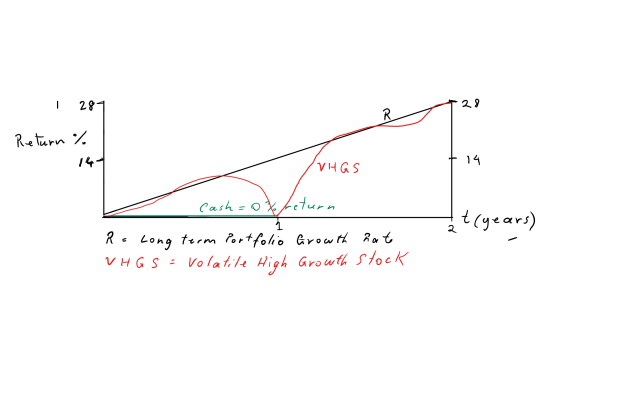
stock-discount-chart

For cash held for less than a year, then the discount from P (r) would need to be relatively less, while still enabling the stock to attain the same portfolio ( R ).  One source of error in purchasing stocks, especially volatile high growth stocks, is failing to patiently wait for an adequately low price.  In my proposed strategy of using accumulating cashed dividends to fund new stock purchases, the fact that the cash balance builds up slowly as dividends are contributed, is an incentive to wait for an adequately low price so as to generate returns at least equal to ( R ).  This is because frequently making small investments which use up the accumulating cash, if made at a discount to P (r) which is less than t (cash) times ( R ), will result in subpar long term returns.

There remains one question: if the stated goal of a rational policy of accumulating cashed dividends and reinvesting them, is to merely match the long term growth rate of the portfolio that would be attained if the dividends had been automatically reinvested in their respective stocks in the first place, then what is the point of hoarding the dividend cash in the first place?

The reason is as follows:  some stocks seem to have a higher expected growth rate because of the strength of their business and market expansion.  However once this is well recognized by the market, the stock in question becomes chronically highly priced, and is rarely available at an attractive price.  However, these stocks can yield great returns if they can indeed be found cheaply.  And, inevitably they sooner or later do fall in price.  In fact, when a company from which the market has high expectations (ADBE), meets a setback, it is generally swiftly punished and its stock falls more than would be the case for a company with a solid business but from whom the market has more conventional expectations (Philip Morris International).  This type of company might be termed a Volatile High Growth Stock. The above strategy of accumulating cashed dividends to take advantage of these infrequent opportunities can then in fact lead to overall increased returns.

Again the promise of higher returns by a high growth stock is only likely to be fulfilled if the purchase price is low enough.  On this inarguable basis,  a sound strategy might be to buy the target stock with half of the available cash when it reaches a % discount from the previous 52 week peak, that is equal to the 10 year growth rate for the portfolio ( R ).  Should the target stock fall to 2 x ( R ) from the same previous peak price, then the remainder of available cash will be invested in it.

This strategy may not be perfect, for example it may result in only half of the available cash being invested in the target stock at an attractive price. On the other hand, it preserves the chance for purchase of at least some of the target stock at the truly great price of a 30% discount to previous peak. This approach should at least preserve the average portfolio growth rate from damage caused by ill-advised purchases.  Meanwhile, If the target stock is one with growth rate relatively higher than the average for the portfolio, this should raise the portfolio performance.


Bought more ADBE in 2016; reflection upon the emotional aspect of the trade

January 19, 2017.  On January 11, 2016 I sold 6.5% of my MSFT stake to buy ADBE.  I thus somewhat more than tripled my stake in ADBE, which nevertheless made up only 5% of my portfolio as of 12-31-2016.

The timing and pricing of this trade was as follows.  In August-September 2015 the market sold off by 10%, then recovered, only to sell of by approximately 12% in January 2016.  ADBE had bottomed on 8-24-2015 at 75, down 13% from its previous peak at 86 on 8-17-2015.  It then rose again to peak  at 95 on 12-29-2015 before falling 22% to nadir at 74 on 2-9-2016.

 I bought ADBE at 88 on 1-11-2016,  down less than 8% from the 12-29-2015 peak of 95.

In fact, since 1-11-2016 MSFT is up 20-83%, ADBE up 19.56% as of 1-18-2017.

But MSFT pays a dividend of 2.35% currently,  That trade isn’t looking too impressive. Bear in mind of course that the prices of both fluctuate, so on a different date, the assessment would be different.

Had I bought at the nadir of both stocks with MSFT at 75 and ADBE at 74 on 2-9-2016, since than ADBE up 46.24, MSFT up 26.89 not counting dividend, as of 1-18-2017.

adbe-msft-2016-chart

The rationale for the trade was that ADBE is a high PE stock with expectations of high future growth which have become well recognized by the market. This type of stock rarely trades at an attractive, relatively lower purchase price. I wanted to increase my holding of ADBE and wanted to take advantage of a lower price. I still agree with the decision to increase my holding of ADBE, but obviously I totally missed the true opportunity for a better price. 

This episodes proves again two timeless investing truths.  First, it is true that valuable and expensive stocks will be available at a better price, if you can only be patient.  Second, if you feel impelled to do something less you run out of time, just again, be patient. In fact using more time to decide will result in a better outcome.  This is not the only time that it would have been more profitable for me to wait for a better price.  In fact it is a recurring theme. 

But upon reflection, I find that this conventional lesson only probes one layer of this experience.  A distinct lesson is provided by considering the emotional aspects of the trade.

First, I felt I was missing out by not owning more of ADBE, a wonderful company with an insurmountable competitive advantage in its business (digital media) which it is strengthening, while building a second business (digital marketing) which looks likely also to have a sustainable competitive advantage.  This created a sense of urgency to trade.

Second, since I held no cash, I needed to sell another holding to buy more ADBE.  All of my 5 stocks are treasured holdings.  Part of holding such a concentrated portfolio is the nagging thought that perhaps I should be more diversified, at least within my 5 holdings.  This added to the anxiety surrounding the trade; on one hand, I should trade into ADBE, on the other hand, I was reluctant to sell my other holding.

the emotional aspects of investing must be explicitly embraced and addressed, rather than just suppressed.  Same as in the rest of life.  Remembering that good investing is a model for a fruitful life, lived to its fullest potential.

In perspective, the sum of money used for this trade was a very small proportion of my portfolio , less than 3%, as to make only a small difference at best.  This suggests that instinctive fear led me to avoid putting a healthy proportion of my portfolio on an investment.

Regarding strategies to reduce the roil of emotions interfering with sound trading next time.  One suggestion is to create a relatively fixed, preplanned trading strategy.

For instance,  wait until it is reduced 10% from the peak and use half of the money available for the sale.  Then use the rest when or if the 20% discount is reached.

This assumes that you really want to own the company.  If it is a new investment that may not have the same conviction as a better understood, long term holding, then waiting for the full 20% discount is probably best.

Second, in order to isolate the decision to purchase from the reluctance to sell a current holding, it would be helpful to have a source of cash for new purchases.  This is the topic of a subsequent post. 

The lesson to be learned from this episode is not just that patience is a virtue in investing.  For the barrier to patience is often posed by the emotions impelling a trade.  One cannot simply make one’s emotions disappear.  I for one, have been successful in making them disappear so far, and I am surely not alone. 

A better approach may be to 1. analyze the source of the emotions.  In my case, my rush to trade and poor decision making was not simply from a greedy rush to chase a hot stock.  By understanding the source of the feelings, you can know how to neutralize them.  2. have a strategy to avoid a repetition. For example, I will trade at specific target reductions in price, and not worry about trading until then, merely watching the market prices regularly.  I know my portfolio is sound as is, there is no urgency to trade unless it is actually at an attractive price.  3.  have a source of cash  for purchases.  Again, this point will be the subject of a different post.

In sum, the emotional aspects of investing must be explicitly embraced and addressed, rather than just suppressed.  Same as in the rest of life.  Remembering that good investing is a model for a fruitful life, lived to its fullest potential.

Continue reading

Essential Criteria of an Amateur Investor investment.

edited 4-4-2016
1.  Sustainable Competitive advantage defending or growing market share in its specific market.  This is the sine qua non of our investment choices and the foundation of our approach to investment.  The company with a competitive advantage is rare.  It is marked by the ability to increasingly attain returns on investment above its cost of capital, and above those of its competitors.  A competitive advantage might be made durable by low cost/high volume leadership among competitors; barrier to market entry of competitors; product differentiation/switching costs to customers.  The company with a sustainable competitive advantage sells an indispensable product.

2. No competitive advantage truly lasts for ever. Hence, a related critical facet of the competitive advantage feature is that management consistently anticipates or reacts to changes in the market or competitive landscape by finding profitable ways of extending the company’s competitive advantage into new markets that are tangibly related to its current markets. That is, the company adapts and evolves to perpetuate its competitive advantage by extending it into the evolving new markets.

3.  Evidence of devotion to shareholders by its capital allocation, manifested in the following ways
stock buybacks to reduce share count
avoiding excessive dilutive stock compensation
obtaining good returns on investments in acquisitions
aligning reward and performance of management and employees to reward shareholders and long term company performance
allowing shareholders to have voting power commensurate with their stock ownership.

4  Common stock of publically traded company based in U.S. or other relatively transparent legal environment with respect for property rights, at least 10 years old.

5. The investment worthy activities of the business are demonstrated in the record of its past and present achievements, not in the hoped for future.

6.  quantitative evidence of ability to obtain returns on investment above cost of capital, such as low debt level, growing free cash flow, high free cash/revenue, high gross margin, high ROE and ROI.

2015 a year of realization, refocus, and anti-diversification

Jan. 4, 2016.  Amateurinvestor beat the market soundly in 2015. The 1 year return was 23.7%; 3 year: 22.1%; 5 year: 21.6% and 10 year: 15.3%. The S&P 1 year return in 2015 was -0.73%. As of 1-5-2016, S&P 3 year return was 11.2%, 5 year return: 9.58%, 10 year return: 4.70%. Therefore I have approximately doubled the S&P returns for 3, 5 and 10 years.

The relative proportions of my holdings are as follows:

MSFT 48.75%
CNI 4.6%
SBUX 19.7%
V 24.7%
ADBE 1.4%

The portfolio is rather focused, in fact the number of stocks dropped from 8 at the beginning of the year to only 5 stocks today. I would like to share some thoughts regarding my sale of 2 companies this year, Cerner (CERN) and Intuit (INTU). I sold these because I realized their purchase was a mistake.

I bought Cerner in October 2013 at $57.75. Cerner is the largest dedicated digital medical records software provider, has an impressive gross margin and a business with a high proportion of recurring revenue and switching costs. I bought it because it has an impressive record of growth for over 35 years. It provides a software platform is a critical part of its client’s business operations. It has staying power and seemed to have a durable competitive advantage. At the time I bought it, I owned just 6 stocks, which seemed to me to be very few, even for a focused portfolio. It seemed wise to diversify into a new strong company I had found. I had a few small doubts at time of purchase. At the time CERN had risen because of recent success in agreements to sell its software and services to major medical centers, particularly Intermountain Healthcare in Utah. I knew it was richly valued. In addition, it regular buys shares to compensate for share based compensation, but still manages to continually increase its share count, which casts doubt on its dedication to shareholder value. Unfortunately, events have shown that because of its high valuation, any miss in analysts’ earnings/revenue estimates are met with a drop in the stock price. There has been some loss of important customers to competitors recently which casts a little doubt on the invincibility of its moat. I decided to sell on August 10. At this point I was uncertain how well it would recover from the market instability of that time. Moreover, I was provoked by a quarterly revenue miss. Overvalued stocks with evidence of weakness in their franchise do not do well in market downturns. I sold at $65.40, at a modest gain, so the damage was limited. On Jan 6, 2016, CERN was at $57.9.

My error in this case was a failure to understand the Cerner business well enough either to a. be convinced that its earnings would continue to grow safely in spite of current overvaluation and related vulnerability to temporary downturns, or b. realize that it’s competitive advantage and dedication to shareholders were lacking and therefore not good enough to earn a place in my portfolio.

Underlying this mistake is a more fundamental and common error, that of impatience. I could have simply taken the necessary time to analyze the company before buying. Had I done so, CERN would have been available at a little less than $50 several months later in May 2014. In any case, the allocation at the time of purchase was approximately 0.8% of the portfolio, so the damage was bound to be limited. I cautiously limited my allocation because of my trepidation regarding valuation and other factors mentioned above. In fact, one might ask what was even the point of investing such a small amount in this company. To this I can only reply that I acted from intuition instead of analysis. The advantage of this is that it certainly limited the damage caused, while adding experience. The avoidance of serious mistakes is an important part of investing success.

Upon reflection, I note that I cautiously limited the size of my allocation, and also that I feel a needed a deeper understanding of the company, and that I could have been more patient. We will revisit these points later.

Intuit is an apparently attractive business, with a dominant share in small business accounting software, and market leading shares in retail DIY tax software and professional accountant tax software. As are Cerner, Microsoft (one of my favorite investments) Intuit was a survivor of the early 1980s boom in computing. As with Cerner, it seemed to be a judicious addition of a long lasting company with clear competitive advantages to my portfolio of so called eternal companies. I bought it in February 2015 at $91.00. It seemed somewhat overvalued but I attributed this to the well-established strength of its franchise. It has introduced Quickbooks Online, a cloud based version of its dominant Quickbooks small business accounting software. Other than Turbo tax, the market leading consumer tax software, the other anchor of its competitive advantage is (was) Quicken, software for home finance management.

In August 2015, again at a time of market turmoil, Intuit management made some capital allocation decisions which shook my confidence in their competence, namely the decision to divest Demandforce and Quicken. Intuit had acquired Demnandforce, an email marketing company for small businesses, in 2012 for $423.5 million. Intuit thought to integrate it with Quickbooks. 3 Years later, CEO Smith explained the abrupt decision to divest this recent acquisition made for over 10% of its 2012 revenue at the related investor presentation. He matter of factly stated that Demandforce and QuickBase [another business divested at the same time) are great businesses, but they do not support the QuickBooks Online Ecosystem and both serve customers that are up-market from our core small business customers.” When asked by an analyst to address Intuit’s record of acquisitions, he stated “many of the larger ones have not gone well”. “…We have a mixed record in terms of bolt-on businesses, new businesses that may not plug-in directly with QuickBooks or tax businesses…” and promised that management had developed a “set of criteria that [future acquisitions] have to meet”. In other words, he was promising that 32 years after its founding in 1983, Intuit would begin to ensure acquisitions make sense for the company before purchase. Obviously these words are not those of a CEO of an eternal company. Quicken was one of its original businesses at the founding and was providing over 20% of revenue in FY 2014. I was surprised by the decision to divest this instead of adapting it and continuing growth.

The poorly planned capital allocation into Demandforce and the abrupt divestiture of Quicken gave me the impression that Intuit management may not be able to adapt successfully to future markets. I had bought in February 2015 at $91.02 and sold in September at 89.26. I found it difficult to pinpoint where I went wrong here. Intuit seemed to be a sound and strong business, providing necessary products which had market leading shares. Perhaps if I had read more of the past financial reports, I would have discovered other episodes of poor acquisitions. Perhaps I should have simply observed its progress over enough time to get a more detailed impression of how it functions. Prior to its purchase, I had considered Intuit to be a strong business with an economic moat which was akin to those I owned. I actually sold shares in Visa and Starbucks, both of which were highly valued by conventional measures such as cash return, to buy Intuit. As happened with Cerner, I felt I lacked deep enough understanding of the company and its management, without which I was vulnerable to nasty surprises.

In the case of both Cerner and Intuit, I felt surprised by adverse company events, and retrenched back to my long term holdings. Therefore, 2015 was a year of realization, that buying companies which seem to be good businesses, and even to have a durable competitive advantage, is not enough. they must be observed to dominate their markets for the foreseeable future, and be observed to demonstrate management competence and respect for shareholders over some time, until one is convinced.

But how is one to judge when the evidence is enough to justify buying and holding forever? Sometimes the clue to a solution to a life problem can be found in a careful reflection upon the experience, and asking the question, “how did it make you feel”. This is because the correction solution is only correct if it is the right one for yourself. In the case of investing, as Benjamin Graham stated, “the investor’s chief problem, and even his worst enemy, is likely to be himself” (Intelligent Investor). The investor will need to be comfortable holding his security in the face of inevitable market fluctuations. In this case, as previously noted, I reflected that I did not feel I had a profound enough understanding of the company to feel comfortable holding in the face of a market downturn. The solution then is to wait and continue to analyze the company until I feel I know it well enough to be able to commit, or not. There are also cases of companies which are actually worthy, but seem overpriced, in which case one would wait for a market downturn even after having come to understand the company sufficiently.

This process of coming to understand the company is not purely intellectual. For example, I doubt a simple analysis of financial statements prepare one for Intuit CEO Smith’s rather absurd explanation of his failed acquisition of Demandforce. I believe rather than one must experience the company as much as is possible via its communications, perhaps its products, and by communicating when possible with clients, customers, employees. One must build a relationship with the company, until one feels one can trust it. This is actually what the legendary investor Philip Fisher (author of the book Common Stocks and Uncommon Profits) termed “scuttlebutt”, the flow of information he held indispensable for analyzing a growth stock.

Exploring a company which seems promising, and might rise in value, while waiting to feel fully comfortable enough to commit before buying, is difficult for two reasons. First, it requires patience. Inevitable, one is afraid of missing a low price. Second, it is surprisingly difficult to be motivated to really experience a company, to form a relationship with it, unless you have an interest in it. This may lie behind the investing approach of the excellent hedge fund ValueAct Capital. The investment staff study a company until it seems to be a good bet, then buy a small share and continue to follow it until they know it well enough to feel they know how it makes money, and what to expect from it. They then deepen the relationship by buying a stake large enough to command a board seat, and continue becoming part of it. Perhaps by buying a small stake in a company, I can be motivated to follow it closely enough to understand it better. Seen in the light of these thoughts, perhaps my cautious forays into new additions to my portfolio may not be faulted too much, but in fact be considered a necessary step to taking the time to come to know a company. And by limiting the size of initial investment, I limited the damage caused by errors. But the benefit is that this might be a way to actually discover new gems. Such was indeed the case with Adobe, a small investment I made which was turned out to be a wonderful investment.

Finally, 2015 was a year of anti-diversification, the acceptance that there are truly few companies which have exhibited the qualities of an eternal company in a lasting way, and acceptance that there is no need to diversity just for its own sake. In 2015 I sold Visa and Starbucks, which I had owned for years, and which I knew where companies with very strong franchises, to buy a new company, INTU, which I was less familiar with. Having corrected this error, my portfolio was whittled down to 5 companies. This time, I feel happy with the small number.

But again, reflecting upon this retrenchment back into my small collection of investment gems, I find that the high degree of comfort I have with my existing portfolio, continually reinforces the reluctance to invest in new companies. As my understanding of and satisfaction with my exclusive set of existing investments grows, this sets a higher bar for new companies to meet. And this may actually be an anti-diversification mechanism by which focus investing reinforces its own success.

AmateurInvestor 15.4% 10 yr return beats S&P (5.2%), Berkshire Hathaway (8.69%) for Oct 2015.

Nov. 27, 2015.  My portfolio beat the market this year as well as for the past 10 years. I also beat the 10 (8.69%), 5(10.92%), 1(-8.77%) and YTD (-10.49%) returns of Berkshire Hathaway (Brk.a).  Just saying.

This year’s outperformance is partly due to a realization that the focused portfolio is focused for a reason.  In late 2013 and early 2014 I added some stocks which seemed to fit the criteria to be an Eternal Company, but I could not explain fully why they did.  I did this because owning no more than 4 stocks (V, SBUX, MSFT, PM) felt a little unsettling.  I felt that stringently requiring that they manifestly exhibit the required criteria seemed unrealistic, given that so few companies with these qualities exist.  And so I acquired some more companies, described below, and later sold them. Performance will have been improved by pruning  these companies.

The good results were also related to investments in new additions to the portfolio  which have become permanent investments and have contributed to growth.

In 2015 my portfolio ended with 5 stocks, V, SBUX, MSFT, ADBE, CNI.

This chapter resulted in a few lessons learned.  In the search for Eternal Companies, possibly it is difficult to be adequately motivated to research the company unless you have an ownership stake.  I am reminded that the ValueAct Capital hedge fund acquires a small stake in prospective investments after having done preliminary research, and then continues to perform intensive investigation sufficient to enable a profound understand of how the company makes money and the issues facing growth, before making a definitive investment.  ValueAct is a focused fund.  I suppose I will need to find a way to be more conscientious about researching new opportunities.

The reality that there are very few qualified Eternal Companies does not mean that  investments made in companies that fail to qualify as such will still be as good.  Rather, the dearth of Eternal Companies means an investment strategy focused on these will indeed result in a relatively focused fund.  There is no way around this.  Having proved this more fully to myself, I now feel more content remaining with my exclusive selection of companies.

Another lesson is that I am still capable of making errors.  Fortunately, I am scrutinizing my own execution fully enough to correct errors before they cause serious damage.  Conversely, I am still capable of learning.

Here may lie the most important lesson. Namely, that I can improve the way I invest.  What tools might be best to address the issue at hand, that of picking a company which does not demonstrably meet the required criteria?  One tool might be to write out the reasons justifying investment, as well as any weaknesses with the company, prior to buying.  The narrative would cover a checklist of criteria critical for a good investment. Judgement regarding the criteria is gained by reading, as well as experience. The final analysis should be subject to a critical reading, in which the key assessment can be characterized as asking the question, “does this investment jump out at me as an obvious great investment?” There should be no doubt.

What are the most important qualities of an Eternal Company?  First, the existence of a durable competitive advantage.  This means other companies are not able to compete with the company in its markets.  Second, management consistently  anticipates or reacts to changes in the market or competitive landscape by finding ways of extending the company’s competitive advantage into new markets in a profitable way.

Note that this is entirely different from simply using its financial strength in a attempt to establish a foothold in markets which are entirely new to the company.

Below is a comparison of my returns with those of some renowned value investing mutual funds.

Fund/index Expense ratio (%) 10y (%) 5y (%) 1y (%) Ytd (%)
S&P 500 5.12 11.75 1.06 1.46
Amateur Investor   15.4 22.4 22.0 21.14(as of 11-25-15, est.)
Oakmark Select Fund (OAKLX) 0.95 7.68 14.67 -2.08 -1.08
Sequoia Fund (SEQUX) 1.0 7.28 12.14 -7.71 -8.68

Data is taken from Morningstar.

Following is a brief outline of the qualitative changes to the portfolio in the last couple of years. The companies I bought and subsequently sold at minimal loss – to  – modest profit were as follows:   Fomento Economico Mexicano (FMX, the Mexican Coca Cola bottler and owner of the Mexican convenience store chain Oxxo); Ebay (EBAY, operator of the online auction platform, online conventional merchant marketplace and PayPal, the latter subsequently spun off); Cerner (CERN, the largest dedicated electronic medical records provider); Intuit (INTU, with a dominant market share in desktop personal finance software with Quicken, small business accounting software Quickbooks, as well as growing businesses in consumer electronic tax returns with TurboTax.

I discovered two companies which have become permanent investments.  One is a true Eternal Company, Canadian National Railroad (CNI, one of the seven remaining class I railroads in North America, has the lowest operating ratio of any rail on this planet, and other features that enable it to grow by focusing on growing their customer’s and their own business as opposed to competing on price).

The second addition to my portfolio is Adobe (ADBE software dominates the market for creative professionals, Adobe is now increasing profitability as well as market by shifting from permanent to subscription licensing in the cloud, and in a related market has created software to manage digital media campaigns which is growing in dominance.

Finally, I sold, with some sadness, an Eternal Company for which growth in earnings has recently become stunted partly by a slowing of its market growth, and in addition by the effect of the strong dollar, since its earnings are all outside  the US: Philip Morris International (PM, which has the strongest portfolio of cigarette brands outside the US and is innovating in reduced risk cigarettes).  It cannot match the growth of my other stocks.

Amateur Investor 10 year annualized return (14%) beats S&P (8.12%) in September 2014.

Sept. 17, 2014.  As I have learned more about investing over the past 14 years, my performance has improved, giving me some confidence. In view of this outperformance, I may hope my experience may be of use to others. First of all, this performance shows that an individual investor, spending some hours per week reading and thinking, can beat the market as well as some respected paid professionals (see below).

Personally, I did not have the opportunity to learn about investing until relatively late. It is worthwhile for young people to learn about investing for two principle reasons. First, investing in securities can secure your financial position and afford you the liberty to pursue opportunities that would be much more difficult without available funds to invest in them. Second, investing is in essence, making choices about allocating capital. In learning about how companies go about growing successfully by investing in themselves or by making acquisitions, the investor can learn how to select ways of spending his or her time which will yield the best return in investment. If your parent tells you to study hard because it will be worthwhile, that is one thing. If, based on your investment self-education, you can foresee a good outcome from making certain investments in yourself, then that is entirely more convincing.

The approach that leads to this outcome is based on a few principles. Avoid overpaying for hot stocks. Pay for companies that have a strong business and a long history of the same. Train yourself to ignore market fear, so as to buy those strong business while others are selling them. Know your businesses so you can keep in mind why your contrarian decisions are justified.

A comparison of my returns with those of some respected value investing mutual funds:

Fund/index Expense ratio (%) 10y (%) 5y (%) 1y (%) Ytd (%)
S&P 500 8.12 15.93 19.99 8.93
Amateur Investor   14.00 22.10 25.90 11.90
Oakmark Select Fund (OAKLX) 0.75 8.75 22.50 32.55 11.13 (as of 6/30/14)
Sequoia Fund (SEQUX) 1.02 8.67 19.13 18.45 0.91 (as of 6/30/14)

Note that mutual fund returns are before fees. The expense ratios are noted.

Of course I have some advantages relative to the commercial mutual funds. For me, there are no panicked mutual fund investors demanding that I sell at the bottom of the market in 2009. I can have an extremely focused fund. I can truly ignore the crowd of media and Wall Street with its questionable advice.

Nevertheless this performance is not bad, for an Amateur.

The above information comes simply from my account site online at Vanguard. The mutual fund and index returns are obtained via Vanguard and Morningstar respectively. As I find the time, perhaps I will provide data regarding dates of purchases, sales, and holdings, so as to provide some historical basis and explanation for this performance.

For now, I will note that the portfolio is extremely focused. There is one main portfolio and two much smaller ones. The total number of stocks is 7.