Tag Archives: competitive advantage

Mercado Libre Q2, fY2025: growth-oriented changes in Fintech, Advertising and E-commerce Logistics.

August 24, 2025.

A review of the  Letter to Shareholders for Q2, FY 2025, ended June 30, 2025, tells of the energetic progress Mercado Libre is making in its businesses.

Mercado Libre is focused on strengthening its competitive advantage of switching costs (value provided to existing customers that makes a switch to another provider uneconomic) and scale (the ability to utilize already existing capital to accomplish incremental sales, requiring relatively low incremental costs).  It is doing so by continuing to advance three long term goals of the business, which mutually reinforce these competitive strengths.  These goals are to provide the best value for advertisers in branding and search, build the Ecommerce platform of choice, and to become the largest fintech provider in Latin America.

E-commerce Logistics

Value provided to customers in shipping strengthens the switching costs for Mercado Libre’s e-commerce marketplace. Mercado Libre lowered the price threshold for free shipping from Brazilian Rial (R$) R$79 to R$19 (about US$3.5)  (meaning the slower, free shipping is now available for items starting at R$19), and reduced  shipping costs for sellers for items priced between R$79 and R$200).  This lowers the friction to buyers and sellers of lower priced items.  This is showing promising results with GMV accelerating in Brazil. 

“We are committed to maintaining our competitive advantage in speed as we are convinced that fast delivery will always be in high demand. In fact, we still see solid demand for fast (paid) shipping on purchases below R$79 in Brazil despite the introduction of free (slower) shipping in this price range. “

It is harnessing it’s scale to continue reducing shipping costs and improve shipping times including for the slower free tier of shipping. 

“Those opting for free shipping below R$79 are served with a slower, lower cost layer of our network that leverages existing infrastructure. We have operated this layer with limited volume for 18 months and are now scaling rapidly. Over time, we expect unit costs to fall and slow delivery promises to improve as we innovate, deploy technology and drive more volume through the network.

Mercado Libre is strengthening its competitive advantage over potential competitors. Competitors face the initial obstacle of shipping costs.  Asian ecommerce companies like Temu, Shopee and AliExpress, already offered free shipping on the lower priced items, a segment where they have been stronger than Mercardo Libre.  But Mercado Libre Mercado Libre has built the fastest shipping Network in Latin America. Its low shipping costs are possible because of its scale. 

“Free shipping remains one of our most effective tools for bringing offline retail online and extending our position as Latin America’s largest ecommerce platform. For nearly a decade, we have offered free shipping on a large portion of our business, so we know it is a crucial driver of conversion, retention and customer satisfaction. “

Advertising

Mercado Libre’s advertising platform integrated with Google Ad Manager and AdMob.  This integration expands it reach beyond Mercado Libre’s ecosystem. Advertisers can now seamlessly manage campaigns that simultaneously target consumers both inside and outside our ecosystem.

Fintech

The number of Mercado Pago monthly active users has doubled over the last two and a half years to reach almost 68 million MAUs in Q2’25, and engagement is growing as well. The relatively high yields on funds held in Mercado Pago savings accounts  are key to attracting new users. This strategy has enabled Mercado Pago  to build the largest retail money market fund in Argentina. In Brazil, there are about $180B in popular bank savings accounts which pay approximately 65% of benchmark rate, competing with Mercado Pago accounts which pay from 100% to 120% of the benchmark.  With Mercado Pago’s competitive savings account yields, the nominal quarter over quarter increase in assets under management (AUM) in Brazil, Mexico and Chile in Q2’25 was the largest ever, with the total more than doubling YoY o $13.8B.

“Mercado Pago’s credit card performed strongly in Q2’25, with the portfolio growing 118% YoY to $4.0bn. The credit card was the primary driver of 91% YoY growth in the total credit portfolio in Q2’25. It now represents 43% of the$9.3bn book, up from 37% in Q2’24.  In Brazil, the entire 2023 cohort is now NIMAL positive (NIMAL: Net Interest Margin After Losses), which is consistent with prior cohorts that typically reached this milestone within two years. ” Overall in the various countries the credit portfolio reflects satisfactory risk management.

In the offline Acquiring business, “We continued to gain market share across all major geographies in Q2’25 with Acquiring TPV growth of 53% YoY on an FX-neutral basis. “

Consolidated Financial Results

Net income was negatively affected by a couple of factors.

There was a slight reduction in operating income margin due to added operating expenses from the extension of free shipping .  Instead of taking the relevant revenue from providing shipping, the company is applying the incremental shipping costs as an operating expense to its gross profit.   In Q2’25, income from operations grew 14% YoY to $825mn while the operating income margin contracted slightly by 2.10% yoy.  The reduction in shipping charges was initiated in June, so we might expect further effects from this in the coming quarters.

But this expense is an investment that will result in stronger competitive advantage and increased engagement. Cheaper shipping drives increased engagement with ecommerce, thereby increasing revenue from linked services, including advertising,  In the past, reduced shipping costs have been followed by gains in market share.

There was a non-operating expense, which is subtracted from operating income, which resulted in a lower net income.  This was the Foreign Exchange (FX) losses of $117mn, which doubled YoY, mainly due to the devaluation of the Argentine Peso by 12% in April. As Mercado Libre sales in Argentina have  grown, fluctuations in the Peso value will affect earnings accordingly.  In 2023, there was a much larger devaluation of the Argentine peso by 50%.  That year, FX losses for Mercado Libre were $239 million. 

The Letter to Shareholders also noted that in July, Standard and Poors (S&P) upgraded Mercado Libre to investment grade with a rating of BBB-. Fitch had upgraded it to investment grade last year.  Since its creation in 1999, Mercado Libre has been able to continue growing by successfully making investments in frontier markets, while also dealing with deterioration in the financial conditions, of one or another of the countries in which it operates. And that story of successful business decisions in the face of adversity is one of the things that makes Mercado Libre a remarkable company…

Microsoft Q4 FY 2025 earnings: Azure growth accelerates as legacy business applications transition to Agentic AI

August 16, 2025.

As recounted by CEO Satya Nadella, the Microsoft public cloud service provider Azure revenue surpassed $75B, up 34% year over year (yoy), taking share every quarter.  Azure and other cloud services revenue, as reported in the earnings call slides, grew 39% yoy.  Nadella said Microsoft continued to lead the AI infrastructure wave, now with over 400 datacenters, in over 70 regions, more than any other provider. 

Microsoft  stood up over 2 GW of new datacenter capacity in the last 12 months.  1 GW would supply roughly 800,000 homes in the US. This shows how much new power supply the AI revolution is requiring. 

Data:

Knowledge workers require access to relevant data produced by their enterprise, in order to put it to work using applications. In enterprises whose primary function is not data science, access to data must be provided while enabling unified management and relatively low learning curve. Microsoft Fabric is becoming the complete data and analytics platform for the AI era.  Fabric enables access to all of the enterprise data in one application using OneLake, and integrates with the Microsoft ecosystem.  Revenue was up 55% yoy, now with over 25,000 customers. 

Microsoft also supports third party data analytics platforms on Azure.  Azure Databricks and Snowflake on Azure are also growing.  Cosmos DB and PostgreSQL both play crucial roles in operation of critical OpenAI ChatGPT applications.

In the area of Data, Microsoft continues to evolve crucial third party data management tools on Azure. While continuing its close partnership with Databricks, it is growing Fabric as an accessible and versatile tool that adds value to the existing Microsoft software ecosystem, in this way nurturing its competitive advantage of switching costs.  Customers should be able to access the resources they need to evolve innovative applications, while finding the new capabilities they seek, within the ecosystem.

Agentic AI

This year Microsoft launched Azure AI Foundry to help customers design, customize, and manage AI applications and agents, at scale.

Customers increasingly want to use multiple AI models to meet their specific performance, cost, and use case requirements.  Foundry enables them to provision inferencing throughput once and apply it across more models than any other hyper scale cloud provider, including models from OpenAI, DeepSeek, Meta, xAI’s Grok, and very soon, Black Forest Labs and Mistral AI.

Azure AI Foundry includes the Foundry Agent Service, now being used by 14,000 customers to build agents that automate complex tasks.

As a specific measure of usage, the number of tokens served by Foundry APIs, exceeded 500 trillion this year, up over 7X.

The family of Copilot apps surpassed 100 million monthly active users across commercial and consumer.

Hundreds of partners like Adobe, SAP, ServiceNow, and Workday have built their own third-party agents that integrate with Copilot and Teams.  Also, customers use Copilot Studio to extend Microsoft 365 Copilot and build their own agents.  Customers created 3 million such agents using SharePoint and Copilot Studio this year.

GitHub Copilot users have reached 20 million.  GitHub Copilot Enterprise customers increased 75% quarter over quarter. 

In healthcare, Dragon Copilot usage is surging.  Customers used ambient AI solutions to document over 13 million physician-patient encounters this quarter, up nearly 7X year-over-year.  In a typical use case the copilot creates a progress note of the patient encounter based on the dialogue between the physician and the patient.  The physician is relieved of the administrative work of writing the note after the patient has left.

CEO Nadella stated that revenue from Azure AI services was generally in line with expectations. And, “while we brought additional datacenter capacity online this quarter, demand remains higher than supply.”

As legacy applications transition to Agentic AI, Microsoft is adding productivity and capability to its ecosystem, while enabling new capabilities, such as relieving doctors of admin work!  The success of this strategy is seen in the growth of usage of the various applications, from Dragon AI to Fabric for the enterprise, to Agentic AI for large scale customer service organizations.  But this success is based on more than successful usage.  It translates into cash flow, the key indicator of a truly successful business.

The reason for this ability to translate sales into cashflow, is one of the central competitive advantages of Microsoft: scale.  This has two components. First, is the availability of captive customers.  When a new capability, for example Fabric, is launched, sales are efficiently executed across a massive number of existing ecosystem customers.   In addition, software vendor partners multiply this. That is, the new source of revenue is efficiently scaled across a large number of receptive customers. Scale enables the company to be able to afford the cost of development of the product. Costs which include for example employing engineers, and building or modifying datacenter compute.

Second, the costs of incremental new business is quite low for Microsoft’s software business.  There is a minimal additional cost of selling the 2nd or 3rd or 100th instance of the software.  We refer to the costs of development of the software products as being primarily fixed. The cost of selling incremental additional volumes of the software, which might include setting up additional technical support services, which can serve customers globally from one center, are relatively low. These are called variable costs.

Compare with a company like Starbucks. Each new store that Starbucks sets up, requires investment in real estate, new worker recruitment, training, and logistics for the coffee and food products. That store can sell only in its own geographic location. We seek to invest in companies with a scale competitive advantage, and fixed costs outweighing the variable costs.  

The competitive advantage of scale, is what drives high Gross Margin.  For a company where Salary, General and Administrative costs are well controlled, and debt is conservative, therefore generating low Interest Expense, this means that Operating Cash Flow continues to grow, to supply the Capex which enables the company to readily exploit emerging markets. 

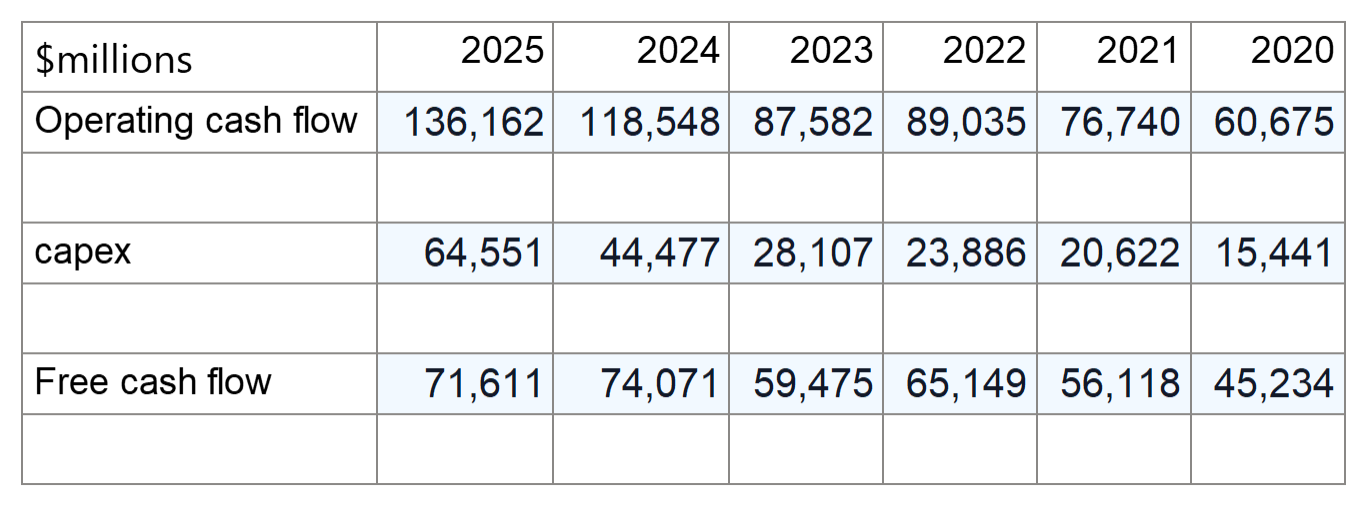
 This cash production is impressively made manifest when we consider the ability of Microsoft to ramp up its capital expenditure to eye popping amounts in recent years, while maintaining large amounts of cash flow.

The table above shows Operating cash flow, capex (PPE expense) and free cash flow for Microsoft, from FY 2020 through 2025.  As shown, Microsoft was able to more than triple capex  from 15.4B in 2020 to $64.55B in 2025, while maintaining free cash flow.  While free cash flow decreased slightly from $74B in 2024 to $71.6B in 2025, it is still ample to supply the company’s needs. Out of Free cash flow of $71.6B in 2025, Microsoft paid approximately $24B in dividends, repurchased $18.4B in common  stock, and had $2.4B indebt interest expense.

In comparison, a startup company supplying an analogous product, has a cost of sales and marketing to purchase each new customer. That’s after building or paying for compute capacity. Furthermore, it must supply at a lower price in order to attract customers who would otherwise use the more complete suite available from Microsoft.  This special effort to  take customers from the large scale provider is necessary because the startup lacks the other, more fundamental competitive advantage that Microsoft has, that of switching costs.  Its customers are (not unwilling) captive customers.  Switching costs are sustained by the continuous research and development of increased value provision in the product ecosystem. Ecosystem customers find it more economic to remain in the system. This never ending evolution of the product sustains the customer base, and is essential to provide the basis for scale.

Outlook for FY 2026:

CFO Amy Hood gave the outlook for the coming quarter and fiscal year.

“Capital expenditure growth, as we shared last quarter, will moderate compared to FY25 with a greater mix of short-lived assets. Due to the timing of delivery of additional capacity in H1 (first half of year), including large finance lease sites, we expect growth rates in H1 will be higher than in H2. Revenue will continue to be driven by Azure.

In Azure, we expect Q1 revenue growth of approximately 37% in constant currency driven by strong demand for our portfolio of services on a significant base. Even as we continue bringing more datacenter capacity online, we currently expect to remain capacity constrained through the first half of our fiscal year”.

In summary, as aggressive but prudent expansion of Azure infrastructure and software tools enables the expansion of data analytics platforms and agentic AI, Microsoft continues to advance as an indispensable host and enabler of the AI transformation, while further enriching its ecosystem.

Q3 2024 Earnings: Adobe integrates AI into its Apps to strengthen its competitive advantage.  Analyst Disappointment with Guidance for Q4 as sideshow.

October 26, 2024: In its 3rd Quarter of FY 2024 ending August 30th, Adobe beat earnings and revenue expectations, both those of analysts and its own.  For no rational reason, the stock price fell up to 10% after the earnings call. The media attributed this to disappointment of analysts with lower-than-expected company guidance for the Fourth Quarter of FY 2024 revenue, of $5.5 to 5.55 B. 

Did it make sense to sell the stock based on this guidance?  Should we worry that the company will miss its standing full FY 2024 guidance? At the end of FY 2023, Adobe gave FY 2024 revenue estimate of $21.3 to $21.5 Billion.   This was updated to a raised estimate, at end of Q2 2024.  The updated FY 2024 guidance is $21.4B to $21.5B (midpoint is $21.45B)

Total revenue in the first three quarters of FY 2024 is $15.899B.  So if Adobe meets the quarterly guidance for Q4 2024 of $5.5B to $5.55B, FY revenue would be anywhere from $21.399B to $21.449B, very likely enough to meet the FY 2024  guidance of $21.4B to $21.5B. Especially when we bear in mind that over 10 years from 2014 to 2023, Adobe has beat its annual revenue guidance 7 of 10 times.

Zooming to the big picture of Adobe’s business growth over time, we see quarterly yoy revenue growth consistently at 10% or better over the last 10 years. Annual revenue growth slowed to 10% in 2022, 2023 and 2023, having been over 20% from 2016 to 2019.   Annual revenue quadrupled from $4.796 Billion in 2015 to $19.409 Billion in 2023.  The years from 2012 to 2014 were marked by a transient period of slowed revenue growth because of the shift from perpetual license sales of the software, to cloud distribution of software paid by subscription.  Instead of receiving revenue for perpetual licenses as an upfront payment, revenue was now spread out over serial subscription periods.  However, the economics of software subscriptions distributed from the cloud mean lower priced software packages with a more limited app selection can be targeted at a much more diverse, larger number of more precisely defined market segments. Demand and usage can be monitored in real time and in response, software SKUs can be designed and released much more responsively than previously, when comprehensive updates of a full suite of software on CDs had to be distributed to brick and mortar stores.  This meant that revenue could ultimately reach a higher level of growth, targeted to a larger Total Addressable Market (TAM).  It is possible that Adobe’s revenue growth slowed in 2022 because once growth had accelerated to meet the new TAM demand, the growth rate slowed to reflect intrinsic market growth.  On the other hand, the slowing in revenue growth might well have been caused by the contemporaneous interest rate increases, fears of recession and consequent slowing in business spending.

I have not done the research to find the answer to this question.  It is not our job to forecast or explain changes in the economy and whether they affect the company.  Our business is to examine whether our investment of choice is maintaining and strengthening its competitive advantages, and extending them to the evolving markets in order to perpetuate its growth Ad Infinitum.

The AI revolution presents a surge in market demand. Adobe is exploiting this by integrating AI capabilities into its current applications and developing new AI-first applications.

Generative AI facilitates and accelerates content creation, its processing into final product, and its targeting to personalized market segments at scale. It makes this work more accessible to a wider range of knowledge workers. 

As described in the earnings call and recent investor conferences, Adobe is executing its strategy of Integrating AI into its flagship Apps. Multiple Adobe Firefly AI powered features have been integrated into the Creative Cloud applications. The online platform Adobe Express incorporated generative AI in 2023 to accelerate and ease content creation using the Creative Cloud apps. In the Document Cloud, the Acrobat AI Assistant enables users to quickly extract value from documents

The strategy is to use the AI features to streamline repetitive tasks and accelerate workflows within the apps, removing the pain points and some of the learning curves of content creation.  As Adobe leadership have repeatedly described over the past year at various investor presentations,  AI integration increases customer acquisition, retention and profitability.  Usage of Firefly Generative AI in the apps continues to accelerate, crossing 12 billion generations since launch. Usage of Adobe Acrobat AI Assistant grew 70% quarter over quarter.

Adobe Express is a streamlined, user-friendly, AI-first platform in which Firefly AI capabilities are made immediately available to utilize Adobe creative applications.  Adobe Express showcases the power of AI integration in the exemplary flagship creative applications, to attract and retain new, non-professional users. In the business environment, Express empowers knowledge workers who are not professional graphic design content creators, for example in marketing, sales and others, to customize branded content for the final intended business marketing application.  Adobe’s AI-powered features are designed to be commercially safe because all AI models created and used in Adobe software are guaranteed to be free of 3rd party intellectual property.

In fact, as stated by David Wadhwani, President of the Digital Media Business, With Express, “we’re on a multi-year strategic journey to dramatically expand our reach across customer segments.” As go-to-market activities are ramped up, Express is targeted to individuals, Education, Teams and Enterprises. As a result, Q3 saw 70 % yoy growth in cumulative exports. Over 1,500 businesses and millions of students were onboarded.  Exports are a relevant indicator of customer acceptance of the product, because if the user created and exported content to another application, that means that Express was used to finish the content product.

In the Adobe Experience Cloud Adobe Sensei has evolved as an AI assistant in the Adobe Experience Platform URL.  This facilitates usage by providing guidance and streamlining tasks. It is based on LLMs of Adobe product facts and best practices, as well as AI models of customer data and goals.

Firefly Services is a comprehensive set of generative AI and Creative services that automates workflows using the suite of apps in Creative Cloud and Experience Cloud.  It takes over repetitive and labor intensive tasks to accelerate production of content at scale, facilitating personalization or modification for specified target audiences.  In addition, customers using Firefly Services can order Firefly Custom Model Integration. Custom models are trained on customer’s branded assets to create campaigns that match a brand’s specific style. 

In Adobe GenStudio, AI is natively integrated with Creative Cloud  and Experience Cloud (including Adobe Experience Manager and Experience Platform) apps to empower marketers to quickly plan, create, store, deliver and measure marketing content and drive greater efficiency in their organizations.  GenStudio was released to beta testing at Adobe Max last year and was just released to general availability as GenStudio for Performance Marketing at Adobe Max 2024. 

Adobe has Competitive Advantages Particularly in the Enterprise.

The integration of the Creative Cloud and Experience Cloud apps means they mutually reinforce their competitive advantages of switching cost.  This integration serves the customer desire to streamline and simplify usage and execution.  As Anil Chakravarthy, President, Digital Experience Business, stated, “Through the integration of Experience Cloud and Creative Cloud, Adobe is uniquely positioned to combine the right content, data and journeys in real time for every customer experience.”   Enterprise customers of Creative Cloud apps are disincentivized from using alternatives to Adobe Experience Cloud software, when this is already integrated into the comprehensive suite of content creation and marketing applications.

Adobe has a large installed base in enterprises. It has high gross and operating margins, with relatively low cost of goods sold. Fixed costs such as R&D are greater than the Variable Costs of goods sold.  For instance, in 2023 R&D was $3.473 Billion, and Total Cost of Revenue was $2.354 Billion. Total Revenue was $19.409 Billion.  This means it enjoys scale advantages.  For instance, developing and integrating AI software into its market dominating Creative Cloud generates a relatively high return, expanding usage across its installed base, while attracting new users.  This would be seen as a healthy Return on Invested Capital (ROIC) in the financial accounting.  The various small younger companies which are introducing generative AI to produce raw content, are faced with the prospect of raising capital and spending heavily on development, including acquiring datacenter infrastructure and attracting software engineers, and when they have created a product, then fighting to win customers in a competitive market. While some of them may prosper in the battle for casual content creators, in the enterprise, they are limited by the switching costs, captive customers that Adobe has nurtured for decades.

Indeed, AI strengthens Adobe competitive advantages.  As described above, AI Assistant in Adobe Acrobat in the Document Cloud, the AI assistant in the Experience Cloud, and Adobe Express AI integration, make the products more accessible by more people in an enterprise or other user group.  For example, In Adobe GenStudio, content produced initially by professional marketing creators using Creative Cloud flagship apps, is subsequently modified and finalized for targeting to specific market segments using Adobe Express, by non-professional marketing or other staff in the enterprise.  This means that more people in the enterprise become habituated to the Adobe software suite, and are disincentivized from switching to alternative creative solutions.  This strengthens the network effect competitive advantage against potential competitors.

Adobe combines competitive advantages of network effects and switching costs.  With its large installed base, it commands a high return on investment of the fixed cost of development of innovation such as AI, relative to the scale of its market share.  This confers economies of scale.

As long as Adobe continues its culture of profitable innovation, which it has since 1982, It will continue to defend and extend its domination of its markets.

Mercado Libre: Mutually Reinforcing Ecosystem Capabilities

May 16, 2024.

MercadoLibre aims to widen the number of users of its off-line, digital payments as well as ecommerce services, by providing digital technology payment and wider fintech solutions. 

We will review the various segments within Mercado Libre marketplace and Mercado Pago, and describe in more detail how their functions mutually reinforce each other to  strengthen the competitive advantages of the company.  There are 6 main ecommerce and digital finance services:

1. The Mercado Libre (ML) Marketplace.

Wide, non-specialized assortment of goods, includes first party sales as well as small business vendors and large brands.

2. Mercado Libre Classifieds

Users list and purchase motor vehicles, real estate and services, for a Listings placement fee.  Classifieds are a major source of traffic to the platform, benefitting both the commerce and fintech businesses.

3. Mercado Shops online storefronts solution

Users manage and promote their own digital stores, hosted for free by ML .

4. Mercado Ads

Businesses promote their products on the ML and MP platforms.  First party data is available to create and target particularized audiences.

5. Mercado Pago (MP) Fintech Platform

Currently, MP processes and settles 100% of transactions on ML marketplace in its largest markets:  Argentina, Brazil, Mexico, Colombia, Chile, Uruguay, Peru and Ecuador, and virtually all transactions in the remainder.

MercadoLibre ecommerce development was challenged by a significant population of persons and small businesses that were underserved by the payment and financial industry and therefore could not liberally participate in ecommerce.  MP was born in 2003 as a fintech solution enabling users to send and receive payments on ML. It evolved to extend its services as an online digital payment app to third party online ecommerce sites. MP digital payments infrastructure enables other ecommerce sites, via MP branded or white label SDKs.  Thus, MP has played an important role in enabling the development of LATAM ecommerce.  It has also provided a second line of revenue, after the ML marketplace, for Mercado Libre.

MercadoLibre has developed “online-to-offline” (“O2O”) products which enable use of financial services in other than online commerce. 

The engine to extending the competitive advantage of MercadoLibre from its ecommerce platform to the brick and mortar financial services market, lies in incentivizing the use of Mercado Pago payment tools for transactions off the Mercado Libre marketplace. Key to this incentive, is the rapid expansion of ML platform users, who adopted MP in order to pay online at ML.

“Online-to-Offline” payments products include:

1. In store payments via MPOS (mobile point of sale) devices and QR  codes.

Generate revenue by sale of devices. MP acts as the merchant acquirer for debit/credit card shopping transactions, generating fees.  Off-line merchants are incentivized to use the MP MPOS device because in this way they capture the expanding number of customers for whom the Mercado Pago digital account or credit card is top of wallet, or in fact their only non-cash payment device. These customers might previously have been unbanked, and therefore limited to less convenient and less frequent cash purchase.

2. An app based digital account for personal digital payments

3. Debit cards to spend from the MP digital account

4. Credit Card, in Mexico and Brazil.

In 2023 Visa branded Mercado Pago Credit Cards launched with rapid adoption in a collaboration which added VISA tokenization among services which enhance transaction security.

5. Insurance such as warranties

6. Savings and investment products

Interest earning savings products bring unbanked persons into the financial system, and attract them to participate in the MercadoLibre network.

7. Cryptocurrency trading , in Brazil, Mexico and Chile.

Mercado Pago, includes Mercado Credito.

Created in 2016, Mercado Credito offers credit to the Mercado Libre ecosystem consumers and merchants, on the MP app and on the ML marketplace. 

Mercado Credito has competitive advantages in underwriting its credit, one which relies on consistent investments in technology to pervasively digitize and harness the data that arises from users of the Mercado Libre ecosystem.  Mercado Libre collects primary data from thousands of user touchpoints within the ecosystem. Machine learning and artificial intelligence generate a credit score based on user/seller behavior in the ecosystem.  Note that for a number of customers, these interactions may be their only salient activity in the financial system.

By leveraging digital user and seller data from the Mercado Libre ecosystem to determine credit scores in internally developed models, MP can provide credit to users and merchants in an economic landscape in which conventional financial businesses have difficulty identifying good credit risks, given the relatively underbanked status of the persons and businesses.  

Mercado Pago has a competitive advantage in distribution, in that it offers credit seamlessly at the point of online sale, priced according to the proprietary scoring system.

Mercado Credito offers credit to users, sellers, and as credit/debit cards.

Sellers Mercado credit extends credit based on sellers historic amount of sales.  Bear in mind that availability of credit to small businesses in Latin American economies is lower than in more developed economies.  Sellers are thus tied to the platform with switching cost.  Interest and principle can be pulled from seller revenue.

For purchasers, Mercado Credito offers a buy now pay later (BNPL) product which can be used on or off the ML marketplace, or at any payment transaction that involves MP.  At checkout, if the user has a credit line, it will allow them to buy on installment by paying interest. Personal loans can be accessed directly through the MP app with the funds deposited into the user’s account. Credit increases user engagement.

Credit card: Mercado Credito enables digital payments for users on and off ML platform, without a conventional bank account.  Proprietary models running in the Mercado Pago cloud control credit issuance.

6. Mercado Envios logistics services

Currently available in Argentina, Brazil, Mexico, Colombia, Chile, Uruguay, Peru and Ecuador. Enables sellers to utilize third party logistics services while providing fulfillment and warehousing services. These services reduce friction between buyers and sellers, integrate the full user experience. Moreover, sellers access shipping subsidies to offer free/discounted shipping. In 2020 Meli Air fleet of delivery aircraft began in Brazil and Mexico and are expanding. The Meli Places network of neighborhood locations to receive and store packages in transit. Buyers and sellers can pick up, send or return packages locally.

Mercado Envios logistics provides better service than national carriers, keeping customers and sellers with the platform. Warehousing enables more efficient inventory turnover, which accelerates sales for sellers. Execution of the strategy has been excellent, approximately 50% of Mercado Envios goods are shipped within 24h, and 75% within 48h. Virtually all Mercado Libre marketplace sellers ship via Mercado Envios.

The Meli+ Loyalty Program is a subscription that enables points, digital entertainment services, offers expanded free shipping.  In addition, it optimizes costs in shipping by allowing buyers to schedule a slower shipping date.  The company groups packages and otherwise uses scale to lower costs. In Q1 2024, approximately 5% of shipping was placed on these slower shipment, user scheduled dates, indicating program adoption, and likely reduced shipping costs (Q1 2024 Earnings Presentation Q/A).    The program was relaunched In Brazil and Mexico in 2023, replacing the previous loyalty program which had proved inadequate. The goal of Meli + is to increase user engagement and this in turn increases seller engagement.

In summary, the Mercado Libre ecosystem includes mutually reinforcing capabilities.  The expanding number of Mercado Libre marketplace users incentivizes brick and mortar merchants to accept Mercado Pago digital payments via credit, debit and wallet. Expanded digital finance services bring previously unbanked customers, to the Mercado Libre ecosystem.  Digital technological cloud assets enable Mercado Libre to leverage customer usage data from its ecommerce platform to sell credit to its relatively novice buyers and merchants, which also ties them to the ecosystem with switching costs.  Efficient logistics services enhance seller sales growth, and this attracts buyers. Growth in ecommerce attracts Ads sales.

United Health Group Competitive Advantages: Scale, Cost, Network  – and Efficiency.

April 25, 2024. How does United Health Group (UHG) drive its competitive strength in the US healthcare market?

United Health Group comprises two distinct, complementary business platforms, United Healthcare and Optum.  UnitedHealthcare offers health insurance benefits under 3 divisions. UnitedHealthcare Employer & Individual serves employers of every size and private or public sector.  United Healthcare Medicare & Retirement serves Medicare beneficiaries, including Medicare Advantage, and retirees. United Healthcare Community & State manages benefits for state Medicaid and community programs. 

Market Share drives scale and derivative network advantages.  Through organic growth as well as serial acquisitions, United Healthcare has become the largest insurer in the US, by premiums written and number of lives covered.  Of note, it has the greatest number of Medicare Advantage clients.  Its market share in a number of local markets is large enough to drive competitive advantages of scale; with a majority local market share of customers insured, it can demand lower prices from medical providers.  Accordingly, it can offer lower insurance premium prices to payer clients such as employers.  The low prices resulting from scale advantages, support the competitive advantage of network effect.  The employers attracted by low premium prices, attract providers who need access to the population of insured patents.

Business diversification confers economic resiliency

Optum contains 3 segments: Optum Health, Optum Rx, and Optum Insight.  These are diverse businesses that reinforce the business agility and competitive strength of each other and the United Healthcare insurance platform. 

Optum Rx is a Pharmacy Benefit Manager (PBM) which creates switching costs competitive advantage related to contracts with employers.  PBM scale attracts drug makers and pharmacies who need access to the insured patient population. Low Cost competitive advantage results because the PBM can demand lower prices from these pharma companies and pharmacies.  These lower prices attract employers, which attracts drug makers in a virtuous cycle.  UNH actually ranks third in market share, among large US PBMs

Optum Health operates medical care providers; chiefly primary care, urgent care and outpatient surgeries, as well as a wide range of ancillary care  services.  Optum Health operational efficiency is guided by data, technology and analytics of Optum Insight, described below. These tools improve care practice and reduce cost. When patients covered by United Healthcare insurance use care from Optum Health, the relatively favorable value/cost ratio obviously reduces costs for the insurance group.  But these attractive margins also attract business from  other insurers. 

The business diversification brought by Optum Health benefits UHG by increasing revenue when medical care utilization increases, such as during seasonal epidemics.  This gives UHG an advantage which pure play insurers do not have because their medical loss ratio (MLR), the proportion of revenue paid in claims, must increase during such episodes.

Optum Health includes Optum Financial, including Optum Bank. With over 24 million consumer accounts, nearly $22 billion in assets under management, Optum Financial facilitates payment flows for consumers, via tools which include Health savings accounts, Flexible Spending Accounts, Health Reimbursement Arrangements and other financial benefits. Optum Financial charges fees and earns investment income on managed funds

Optum Insight is an analytics and consulting service business made possible by the digitalization and exploitation of data resulting from the considerable experience of UHG.  It has likely the largest medical records data collection in the health insurance market, including over 285 million lives of clinical data and claims (URL 2023 10K) In this division, data is harnessed to various important applications for insurers, providers and patients.  Meanwhile, the evolution and growth of the Optum Health care provider business gives United Health Group an experiential advantage that pure play insurers do not have. It serves as a living laboratory of the Optum Insight management intelligence.

In essence, the Optum Insight business consists in harnessing data to increase economic efficiency and consumer, payer and provider engagement in healthcare. Increasingly, this consists of the application of digital tools, with Artificial Intelligence (AI) in an important role. Software tools obtain a higher gross margin than the healthcare provider business they are deployed in.  By reducing friction, improving the patient and provider experience and reducing costs of inefficiencies in the US healthcare system. Optum creates value which drives its competitive advantage.

For providers and insurers, Optum optimizes revenue cycle including coding, billing, utilization review.  Medical records and claims data is exploited using AI, including novel natural language recognition software which it patented. It provides management consulting and clinical quality guidance resources to enable modernization of  administration and improved business efficiency including value based care. Digital transformation reduces administrative costs and delays.

Optum thus provides diverse resources to enable client insurance or care provider businesses to  improve their performance.  Especially the smaller companies in these industries tend to have thin margins. A contract with a consulting client may include a financial or performance outcome which must be attained in order for Optum to be paid for practice changes or software tools it advised and managed.   At times, the Optum Health segment acquires businesses that were not financially successful enough to remain independent, as in the recent case of the national physician practice network of Steward Health.

Optum Insight reinforces the competitive advantage of the United Healthcare Group by increasing efficiency and raising margins of all UHG business segments.  And Optum’s management consulting services do not benefit UHG just by compensation for the services rendered. Contracts whereby Optum Insight is deeply involved in clients operations likely have advantages of switching costs.  Moreover, a client such as a medical provider group which increases profitability because of Optum management consulting, can raise United Health insurance margins by tolerating lower insurance reimbursement, in order to serve the patient population of United Health insured consumers. This is where the larger amounts of revenue is created, as a result of the work Optum does to reduce business costs for the care provider entity, such as hospital or practice. The management consulting work of Optum reinforces the scale and low cost competitive advantages that enable UHG to attract employers and other payers of health insurance.

Of the 4 business segments of UHG, Optum Insights has the highest operating margin.  However, because of recurrent acquisitions, Optum Rx and Optum Health segments have grown faster in size.  Nevertheless, as I described, I feel the business activities housed in this smallest segment are key to sustaining the company’s competitive advantage.

Over 10 years from 2013 to 2022 (I read 10 years of annual reports for this), UHG Operating Earnings were contributed by the 4 business segments in proportions which  changed as follows.  In 2013: United Health: 74%, Optum Health: 9.85%, Optum Insight: 8.6%, Optum Rx: 7.4%.   In 2022: United Health: 50%, Optum Health 21%, Optum Insight: 13%, Optum Rx 16%.  Over the decade, the percentage of Operating Earnings provided by United Health insurance segment declined from 74% to 50% of the corporate total, with those of the other three segments increasing. Earnings of Optum Rx and Optum Health rose more than those of Optum Insight, because they included the earnings of newly acquired companies.

The Operating Margins of the 4 segments have changed as follows: 2013: United Health insurance: 6.4%, Optum Health: 9.9%, Optum Insight: 19%, Optum Rx: 3.1%.  2022: United Health: 5.8%, Optum Health: 8.5%, Optum Insight: 24.6%, Optum Rx: 4.4%. Optum Insight is the most profitable as a business, although it produces the smallest proportion of operating profits.

Regarding current valuation of the stock, the price/earnings (PE) ratio is currently 21, approximately the same as the average of the last 10 years.

From 2014 to 2023, annual diluted EPS rose 4.186 times over, from 5.7 to 23.86 dollars per share.  Meanwhile, ROIC, in mid-teens, and ROA, over 20%, have been quite consistent. Discovering United Health Group (UNH), a Novel Portfolio Holding. | amateurinvestor.net In recent quarterly earnings reports, the stock sells off somewhat when the medical loss ratio (MLR) is reported to exceed analyst expectations, regardless of the fact that UNH beats earnings expectations. It also declined when CMS raised Medicare reimbursement less than expected.  Thus, the stock price is essentially unchanged for the year.

As we intimated previously, a preeminently successful health insurance company such as UHG has a history of continuing to raise revenue and profitability despite the apparently ever-present nemesis of medical costs, and ever reluctant (but inevitably materializing) payment for these costs. Having started a position in UNH about a year ago, ideally I would have waited until some of these transient misfortunes occurred, in order to obtain a lower price.  Apparently, we do not live in an ideal world.

In Optum Insight, digital transformation, including AI, will continue to progress into the healthcare industry, liberating value, and no doubt United Healthcare Group will continue to lead here. Whereas AI is now a “hot topic” and expected to create vast stockholder wealth in a rush, healthcare insurance companies never seem to be popular.  It seems UNH stock is held hostage to expectations regarding the MLR, regardless of its ability to consistently beat earnings expectations. The advantage of this is that it is less likely to rise euphorically, with subsequent dramatic drops in price. Instead, it must earn its way up in price through demonstrated, sustained earnings growth. As it has done, with an average annual return of 25.18% as of April 24, 2024, since March 1990. The total return calculator (including dividend reinvestment) only goes back to that date. But the stock had doubled between IPO on October 16, 1984, and April 1990.

Sustainable competitive advantage drives the choice of investment. CNI: a toll bridge investment on steroids.

Oct 27, 2014.  Competitive advantage does not mean a company earns high returns on capital just because the management is smart. It means that competitors are not able to match its returns on investment. There may be a barrier to market entry, or switching costs for customers are relatively high. The company with competitive advantage can sell its goods at prices well above its cost of sales, without fear that competitors will flood the market and attempt to undersell it. This is reflected in healthy gross margin that is sustained over an extended time, and steady or increasing returns on capital investment.

In the metaphorical toll bridge investment, customers must pay to use the company’s product in order to obtain something they demand. In the literal example of a toll bridge, customers must pay for access to the bridge to a destination. Assuming the demand to reach that destination is persistent enough to justify building the unique bridge, the shares of the company are bid up because of the durability of this demand. The problem with toll bridge investments is that unless demand to reach that destination continues to increase, the company shares will not continue to rise over time. Since the company management recognizes this, it will likely pay a dividend in order to keep investors, as long as earnings continue to support it. Assuming there is no alternative bridge, the company’s competitive position is hard to attack, and management does not have to be world class. Earnings do not rise any faster than economic growth at the bridge destination, the stock price will reflect this. In an attempt to increase earnings more quickly, Management may allocate some income to attempted expansion into other markets, but there it does not possess a competitive advantage and will do no better and possibly worse than competitors who are dominant in those different areas. An example of this is Hawaiian Electric (HE), a regulated electric utility that supplies virtually all power on the Hawaiian Islands. Its growth is limited to the growth of power demand on the Islands.

What if over time demand for reaching the destination not only increased with growth of the most stable economies in the world, but also with the growth of the most rapidly growing economies (thus growing at a rate exceeding the average growth of the world GDP)?

What if the company had exclusive use of 2 toll bridges, with different markets clamoring for access to them? What if the management in fact did not merely rely on the advantaged position afforded by their non-reproducible franchise, but was driven by a historic struggle for economic survival to run the most cost efficient toll bridge possible, therefore focusing its capital allocation on improving its transportation speed and the capacity of its bridges? What if management was systematically incentivized to grow return on invested capital, earnings, free cash flow, and expected to purchase ownership in the company?

What if the toll bridge investment was Canadian National Railway (CNI)?

CN is one of 7 Class I (Freight) railroads remaining in North America (in 1900 there were 132):  BNSF Railway, Canadian National Railway, Canadian Pacific Railway, CSX Transportation, Kansas City Southern Railway, Norfolk Southern Railway, Union Pacific Railroad.

The CN network is a relatively scarce resource.  CN in its current state is a product of approximately a century of transitions to and from government control, mergers and bankruptcies. In the second half of the 20th century successive CN leaders strove to reduce extent of railway track, increase efficiency, and institute technical and labor modernization.  As a result, the profitability of the railway materially improved while the railway assets became much scarcer and therefore more indispensable to the customer, hence the emergence of the toll bridge investment scenario.  While railroad has the lowest cost of land transport to customers, CNI is subject to relatively limited competition because of the limited extent of existing railroads, and the fact that new railroads will not be built because of expense and right of way issues.

The CN network is advantaged by its specific geographic range.

By late 1990s (CNI went public in 1995 as the largest privatization in Canadian Government history), CN leadership had built the distinctive Y shaped map of CN rails.  This stretches from the Port of Prince Rupert on the Pacific Coast, and Port of Halifax on the Atlantic, through Chicago, the transportation hub of North America, and down to the Gulf Coast at New Orleans. Because of a 1998 alliance with Kansas City Southern Railway Company (KCSR), customers can ship from Chicago though out the KCSR network south to Missouri, Oklahoma, Mississippi, Texas, and to Mexico’s largest railway system, Transportacion Ferroviaria Mexicana, S.A. de C.V. which has a separate alliance with KCSR.

Finally In 2008 CN acquired most of the Elgin, Joliet & Eastern Railway Company (EJ&E) around Chicago.  This allows CN to avoid severe rail congestion in the Chicago hub which afflicts other Class I railroads in the area.  Reportedly previously it sometimes took as long to get through Chicago’s 30-mile hub as it did to get there from Winnipeg.

CN rail has exclusive access to ports on the Pacific (Port of Prince Rupert) and Atlantic (Port of Halifax), moreover these ports are privileged in their location.

Although Port of Prince Rupert and Port of Halifax do not have the highest traffic in North America, they rely on CN exclusively for rail link.  Because of its location on the Northwestern coast of Canada, Prince Rupert is closer to Asia than any other North American port by up to 58 hours.  It has the deepest natural harbor depths on the continent.  This allows usage by the very largest and most modern container ships, super post-Panamax cargo ships.  It has little traffic congestion, and this makes it increasingly attractive to shippers compared to congested ports on the U.S. Pacific coast.

Container traffic was added to bulk commodities in 2007 with the first dedicated intermodal (ship to rail) container terminal in North America.  Currently Prince Rupert is expanding the number of super post-Panamax cranes to 8, and adding train tracks.  According to the Prince Rupert Port Authority, surging Asian trade is projected to increase container volumes by 300% into North America by 2020.  The planned expansion will expand the container capacity of the terminal from 0.75 to 2 million TEUs, making it the second largest handling facility on the West Coast.  CN Rail is the only way to take cargo in or out of Port of Prince Rupert.

Development and modernization of the container terminal is funded mostly by Canadian Federal and Provincial Government and Prince Rupert Port Authority; while CNI has paid only a fraction of costs, for rail related development.  Development of this port directly promotes CN revenue but CN pays only a fraction of the required capital investment.

Port of Halifax on the Atlantic coast is the deepest, wide, ice-free harbor (with minimal tides) on the North American Atlantic Coast and is two days closer to Europe and one day closer to Southeast Asia (via the Suez Canal) than any other North American East Coast port.  It is 3 days faster from Rotterdam than NY harbor, 2 days faster from Singapore to NY via Suez Canal.   In addition, it is one of just a few eastern seaboard ports able to accommodate and service fully laden post-Panamax container ships using the latest technology and world class security.

The Halifax Port Authority has invested over $100 million over the past three year on infrastructure and efficiency improvements.

Unlike Port of Prince Rupert, cargo volume at Port of Halifax is not growing steadily yet since the recession nadir in 2009.  9.6M metric tonnes in 2009, 8.6 M metric tonnes in 2013.  Again, the absence of congestion here compared with more southerly ports bodes well for future traffic loads, all to be carried exclusively by CN, when the global economy finally recovers from the effects of the Great Recession.

Management at CNI is a product of a century long struggle to increase efficiency and profitability and this tradition is carried on today.

For decades in the second half of the 20th Century, A succession of company Presidents fought to build a more efficient railroad which could fulfil its potential and be profitable even though it was controlled indirectly by the Canadian Government and therefore treated by its directors as a tool for political or development goals rather than a business.

When CN acquired Illinois Central Railroad in 1998 in order to add the network extension down through Chicago, it recruited Hunter Harrison, former head of Illinois Central, who took control of day to day operations as COO.  A veteran railroad man, Harrison was credited with drastically improving efficiency by implementing “scheduled railroading,” whereby freight trains were operated on a more controlled schedule designed for efficiency.  CN became a scheduled railway, increasing utilization of locomotives, freight cars, and train crews.  Previously, Illinois Central had the lowest operation ratio* in North American railroads, this title soon passed to CN.

Harrison’s recruitment into CN leadership (he became CEO in 2003) is part of a long preoccupation at CN with improving the company’s efficiency and agility as a railway business.  It is this culture which drives CN to continue achieving record margins and efficiency even after having seemingly won the fight against competition.  An interesting place to view this culture of obsession with efficiency is the Management Information Circular and Notice of Annual Meeting of Shareholders of April 2014.  Here we see that CNI aligns management compensation with corporate value creation and profitability.

Because of the advantaged competitive situation of toll bridge assets, management can become complacent because the indispensable nature of the company services means it is relatively protected against competition for the foreseeable future.  In the case of CNI, an overview of non-employee management compensation reveals a focus on rewarding behavior that tangibly increases returns on investment for the company’s capital investment and in turn shareholders.

For example, 70% of the annual incentive bonus is based on attainment of performance objectives: Revenues (25%), Operating Income (25%), Diluted Earnings per Share (15%), Free Cash Flow (20%), Return on Invested Capital (15%).

Individual performance contributes 30% of the incentive bonus.  This is scored based on attainment of personal business-oriented goals considered to be the strategic and operational priorities related to each executive’s respective function, with a strong overall focus on: balancing operational and service excellence, delivering superior growth, opening new markets with breakthrough opportunities, deepening employee engagement and stakeholder engagement.

Long-term incentives include Performance Share Units, PSU, and conventional stock options.  PSU are company shares which vest conditional to the attainment of target ROIC and target increase in share price over a 3-year performance period.  Stock options granted in the same proportion as PSUs, vest over 4 years.

CNI requires management to invest in the company on the same terms as every other investor.  CN specifies minimum required stock ownership by management, to be attained with 5 years from onboarding and then maintained. Stock ownership must be purchased on the open market, or using PSUs or deferred bonuses and held until retirement.  Stock options do not count towards share ownership requirements.

All management subject to the plan exceeded their share ownership requirement at the end of 2013.  CEO Claude Mongeau held over 25x his base salary in shares, and his requirement was 5x his base salary.

CNI suffers minimal compensation related stock dilution, and maintains a strong rate of stock buyback.  As of 2013, about 7.6 million shares are to be issued under exercise of options, less than 1 % of the outstanding shares on the market.  In 2004 there were 1159 million shares on the market, in 2013 there were 834 m shares, a reduction of approximately 28%.  There are no preferred shares.  CN has one class of stock.  Management own the same stock and have similar voting power as myself or other shareholders.

In sum, not only does CN possess assets which will not be duplicated, and a very strong barrier to competition, but in addition management is incentivized to make these assets work profitably for shareholders.  This results in a synergistically beneficial effect on returns on investment for the company and shareholders.

Financial results and valuation

CNI 3rd quarter 2014 earnings of C$1.04 missed analyst estimates by C$0.01, and revenue of C$3.12B (15.6% increase) missed by C$30M.  The headlines might equally as justly have read: “analysts inaccurately estimated CN earnings”.  I do not think of quarterly earnings as a reason to make buy/sell decisions.  However the earnings call contained some items that illustrate the strengths of CN.

CN is growing much faster than GDP growth.  This is expected since international trade increases in complexity and volume out of proportion to GDP growth. CN is in a secular growth market, moreover is not dependent on the health any specific industry.

Revenues and carloads (1.5 million) reached all-time records.  International revenue increased close to 25% while domestic revenue was flat.  International revenue was driven by Pacific Coast (Port of Prince Rupert) traffic, where emerging markets export to North America, with strong traffic into the US Midwest.

Operating ratio reached new record of 58.8%, continuing to be the lowest of all North American railroads.  Incredibly, revenue ton miles, RTM, grew 15.4% at no incremental cost.  These illustrate the unparalleled efficiency of CN rail.

Fuel costs shrank by 3%.  CN plans to increase prices at least 3%, noting that North American rail capacity remains “snug”.  CN is able to raise prices fundamentally because of its economic moat. Management is incentivized to continue attempting to shift service from lower to higher value cargo.

While the strong traffic drove increases expenses for labor, equipment leasing and costs including new locomotives and maintenance, these were significantly less than the increase in operating income of 19% and net earnings of 21%.

Some thoughts on performance in the past decade.  Looking at revenue over 10 years from 2004 ($6.458 B) to 2013 ($10.575B), an increase of x1.61, we see a steady increase, except for a dip of approximately 15% from 2008 to 2009.  This occurred in context of the Great Recession, so is not unexpected, railroad revenue is definitely related to GDP growth.  The steady increase in revenue over a considerable time suggests CNI is dependable as a money maker.  Net income rose from $1.259B to $2.612B, an increase of x2.07 outpacing revenue growth.  Because of stock buy backs, diluted earnings per share increased from $1.08B in 2004 to $3.09B in 2013, an increase of 2.86x or 18.6% per year.  Free cash flow increased from $1.069B in 2004 to $1.575B in 2013, an increase of 1.47.

CNI generated free cash flow of $1.575B in 2013, with FCF/sales of 14.89%.  The lowest such ratio in 10 years was 7.16% in 2008.  The lowest ROIC in the last 10 years was in 2004 at 10.59%, the highest was in 2012 at 16.66%.  Gross margin hit 84.7% in 2013.

Valuation. While CNI possesses unquestionably valuable assets and franchise, its stock has been bid up in recent years.  The cash return measure of valuation tells how much free cash a company generates from its capital, both equity and debt (cash return is FCF plus interest expense divided by enterprise value. Enterprise value is market cap, plus debt, minus cash, that is, cost of the company to a private buyer). For CNI, cash return is 2.8%, not impressive.

Buy decision.  The investment worthy qualities of CN Rail, a wonderful business with a wide economic moat, excellent management respectful of shareholders, have been put in place in approximately the last 10 years or more.  Growth in trade with emerging countries will maintain a secular bull market for CN services for the foreseeable future.  As this has been recognized by investors and the media, the stock price has increased at a rate of growth greater than earnings over that time.  The stock price increased from 12.4 on October 2 2004 to about 70 on October 1 2014, an increase of 5.6 times, while earnings per share increased approximately 2.86 times.  The lowest PE in the last 10 years was 8 in 2009 (10 years earlier in 1998 it was less than 4), currently it is almost 23, the highest ever.

This is a case of a good business with sound prospects that has become expensive relative to its past prices. Investing depends partly on what the future holds, and in judging what to expect here, there are a few variables to consider.  First, will the quality of the business change?  CN Rail has a wide moat and it is unlikely this will change for the foreseeable future.  Second, will investors continue to admire the prospects?  Media and investor sentiment can be affected by factors that do not tangibly change the company.  If there is a change in investor sentiment caused by global events which do not actually reduce CN traffic or ability to price profitably, the stock price might drop and result in a buying opportunity.  Third, will the market for CN services actually change?  Should a global event cause a tangible economic slowdown that reduces CN business, I think we can rest relatively assured that the recession will end, and CN will regain business after an interval.  This again would create a buying opportunity for the patient investor.  Fourth, will investor sentiment remain enthusiastic for CN?  It is possible for popular companies with a recognized wide moat to stock prices that are expensive relative to the underlying business, for a prolonged period of time.  However, this is not susceptible to prediction.  The disadvantage of relying on this is that the stock price holds little margin of safety.  However, if we ask the question, will CN earnings be significantly greater in 10 years than they are now? I think the answer is unquestionably “Yes”.

Performing a simple DCF analysis using current EPS $3.09, growth rate of 18% for 10 years, terminal growth rate 3% for 10 years, discount rate 8$, discounted share price is $99.95.  Using an EPS growth rate of 9%, discounted share price is $58.86.

It might be reasonable to place a relatively small stake on a highly priced business with good prospects.  Otherwise, one might wait, study and learn about the business, building confidence in the value of the business that will enable one to buy with appropriate commitment in the face of future market downturns.

Summary

CN Rail reveal evidence of durable competitive advantage, with outstanding gross margin, as well as operating ratio, good return on investment measures, growing free cash flow.  Management is incentivized to maintain the ability of the company to obtain outstanding returns on investment, and respects shareholder interests.  CN Rail manages assets that are unique and indispensable, for which CNI does not pay all the cost of capital investment.  Moreover, the market for CNI services produces with these assets is growing inexorably, with no damaging competition perceptible on the horizon.  Unfortunately, CN’s top of class status is well recognized by the market and shares have been bid up, to all time high PE levels, so it no longer affords a bargain price.

*Operating Ratio:  the yardstick of railroad profitability, equal to operating expenses as a percentage of revenue.